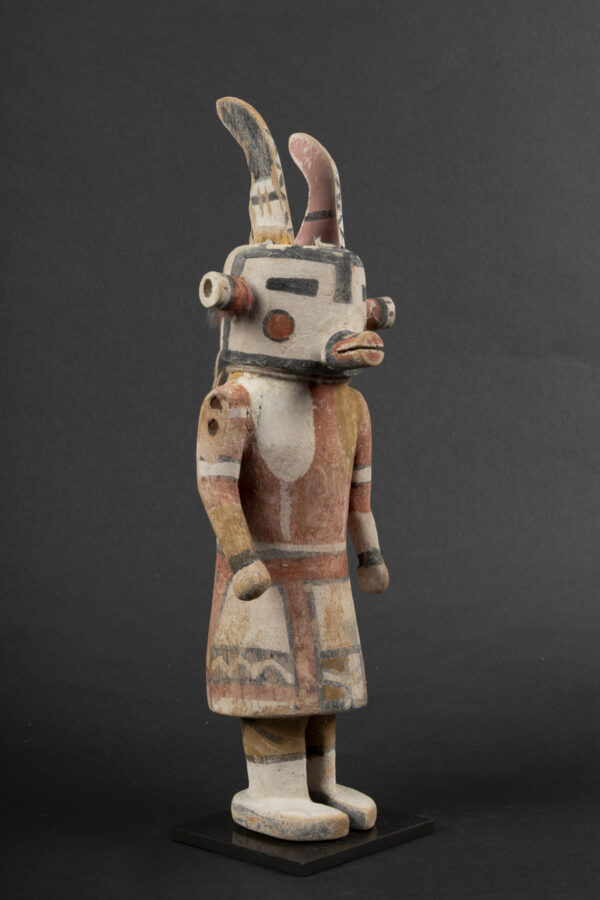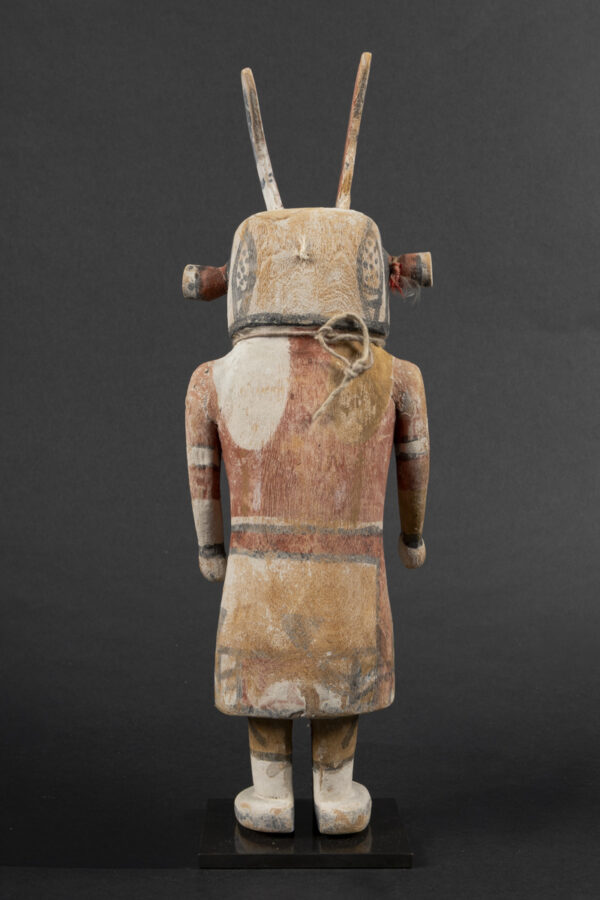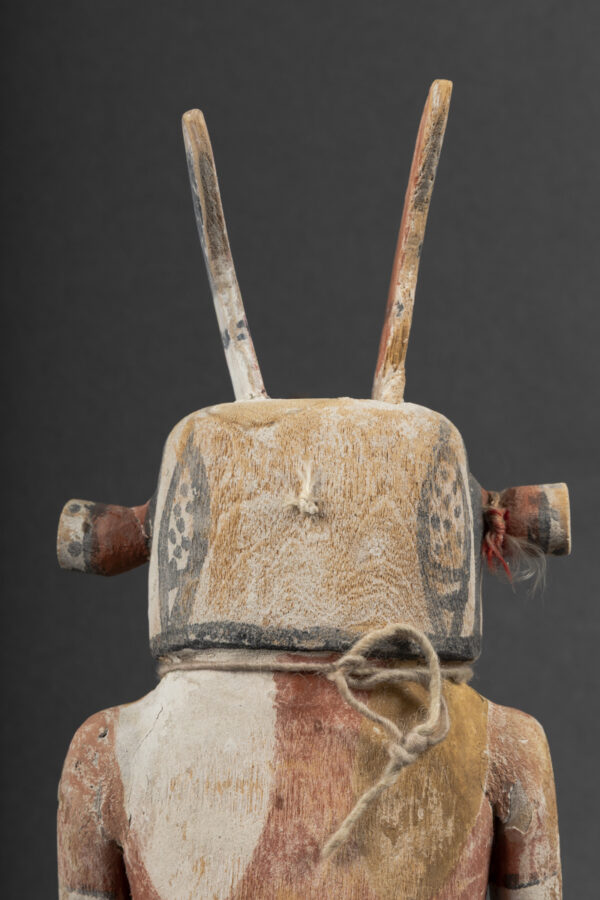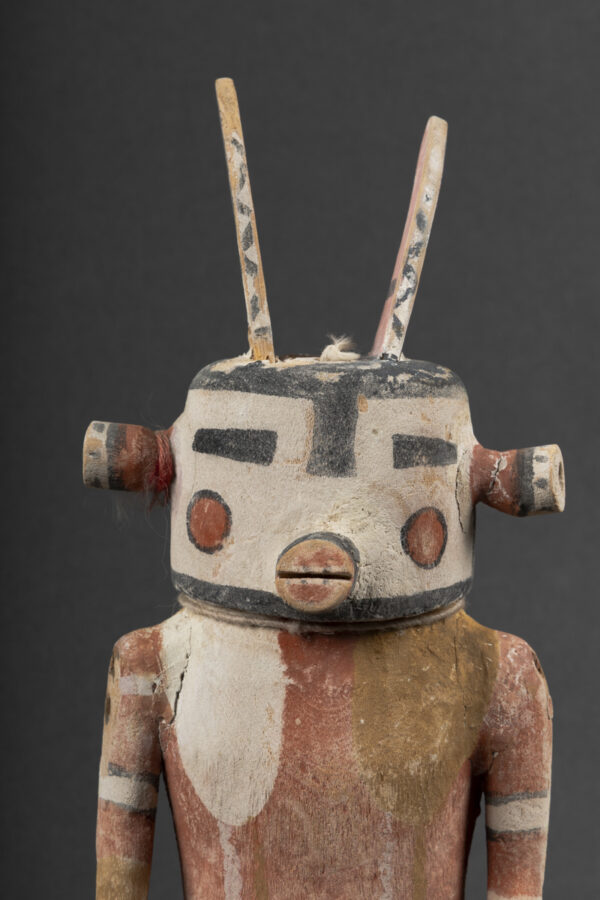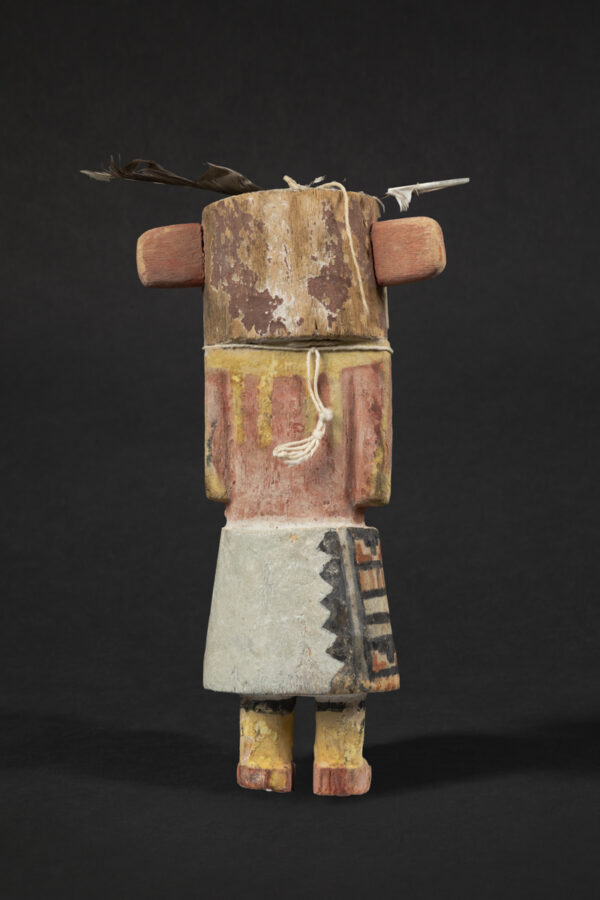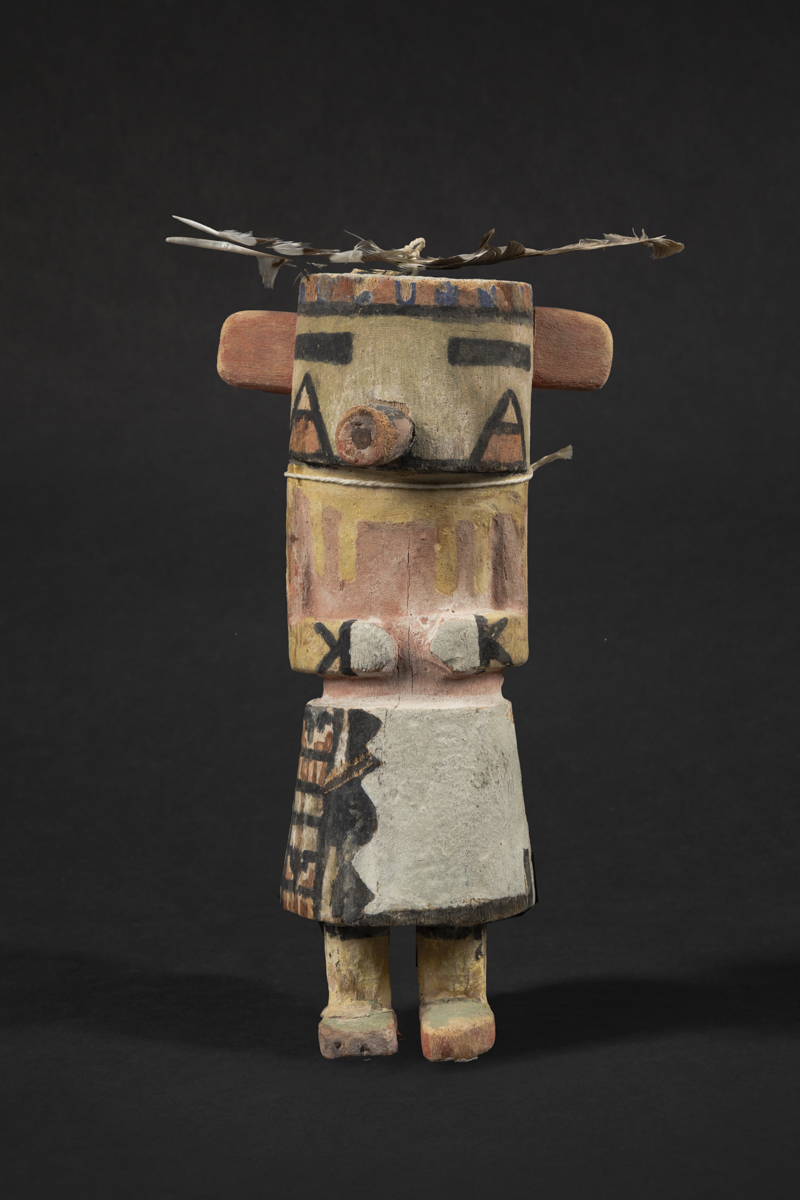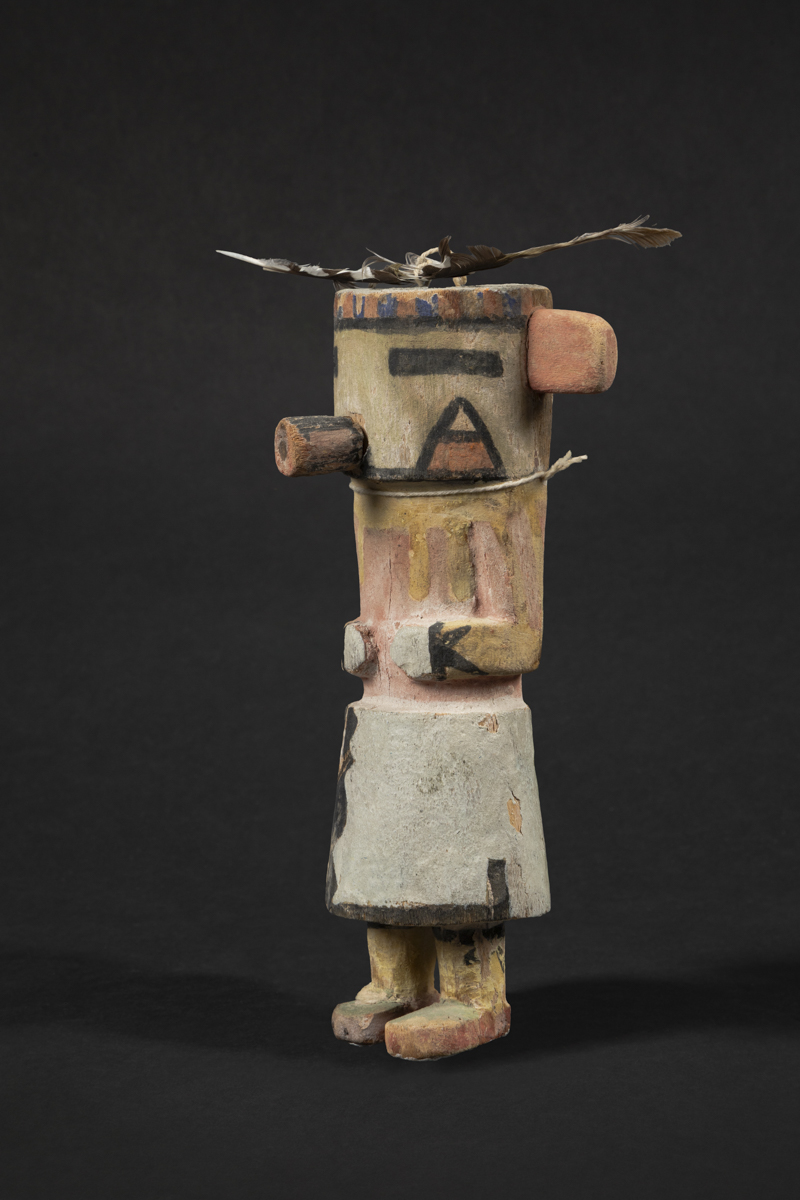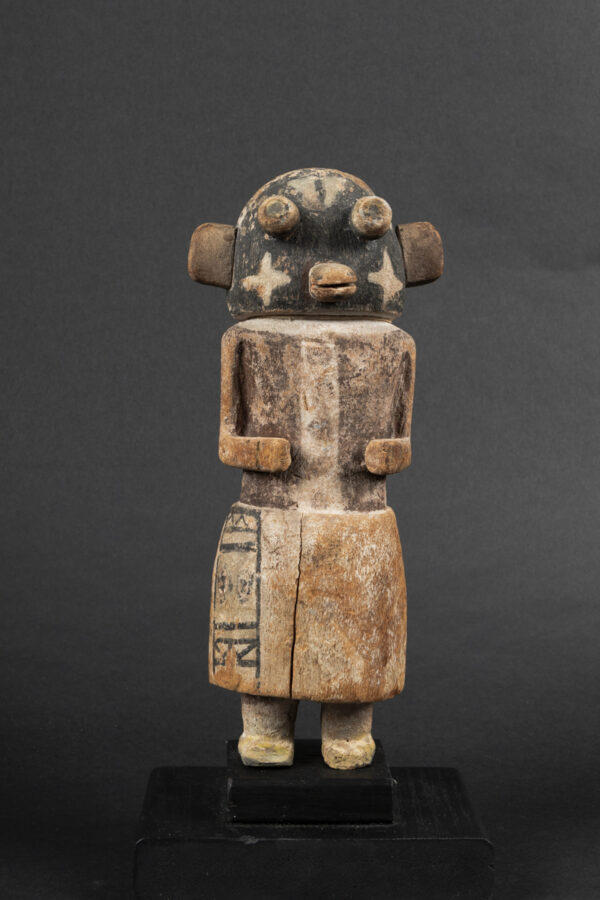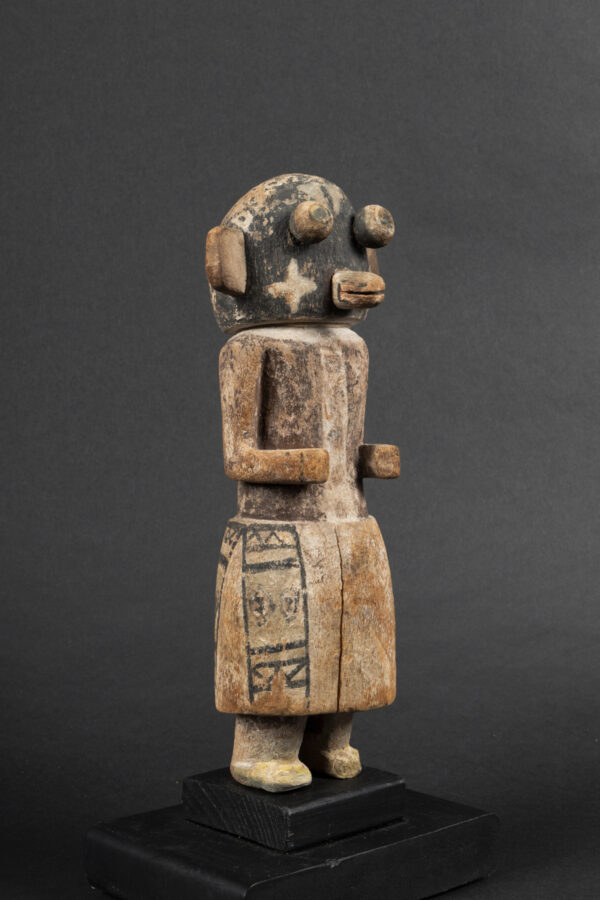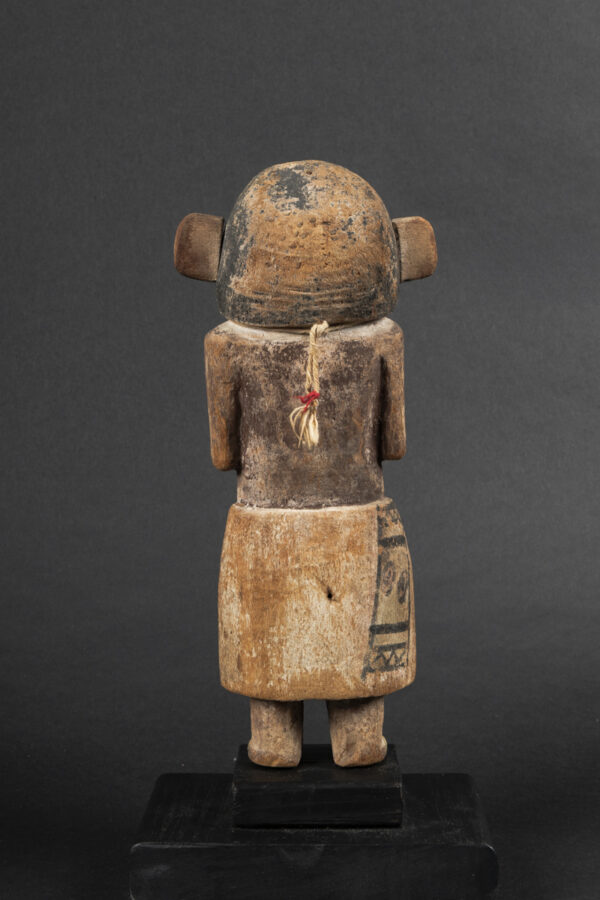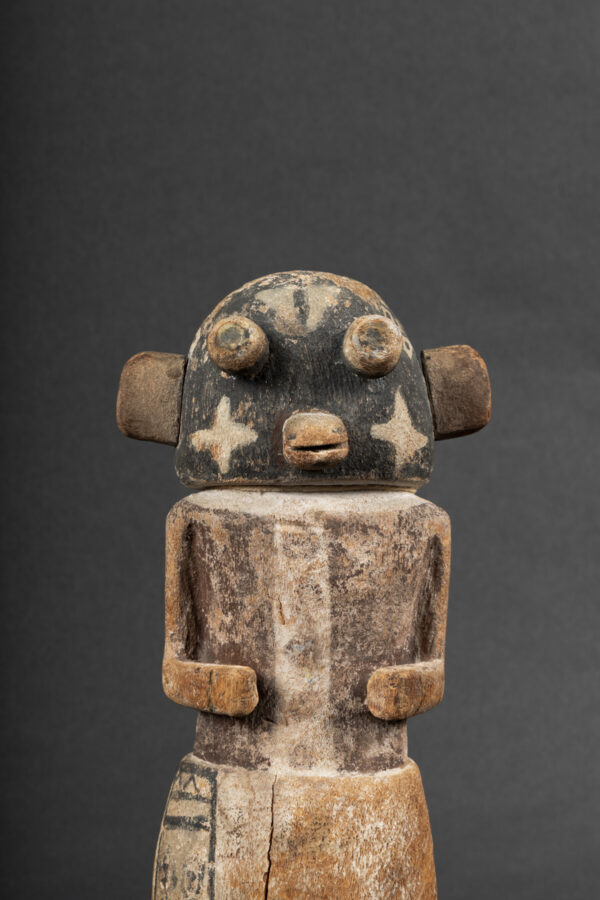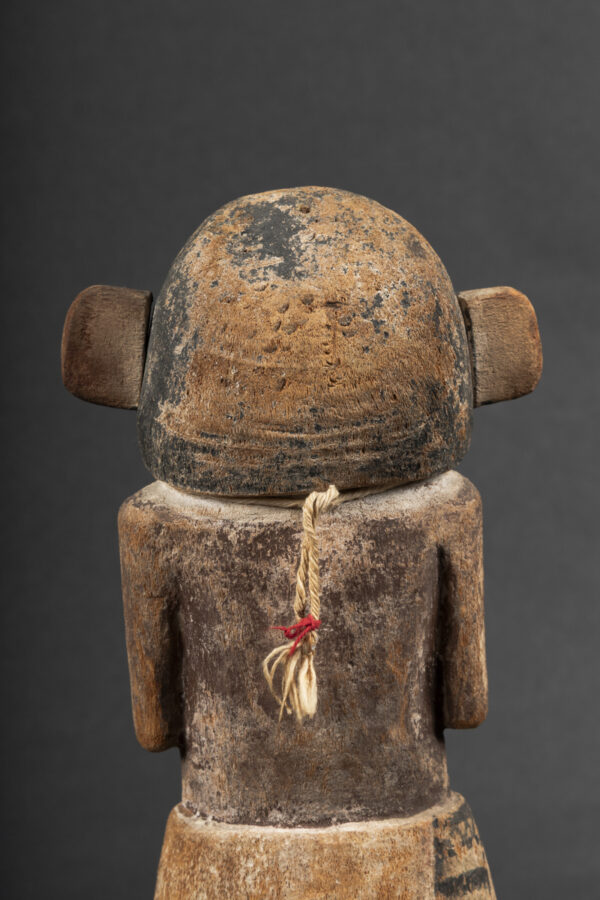
Katsina Doll

Kachina Collection | Arizona

Katsina Doll

Arizona

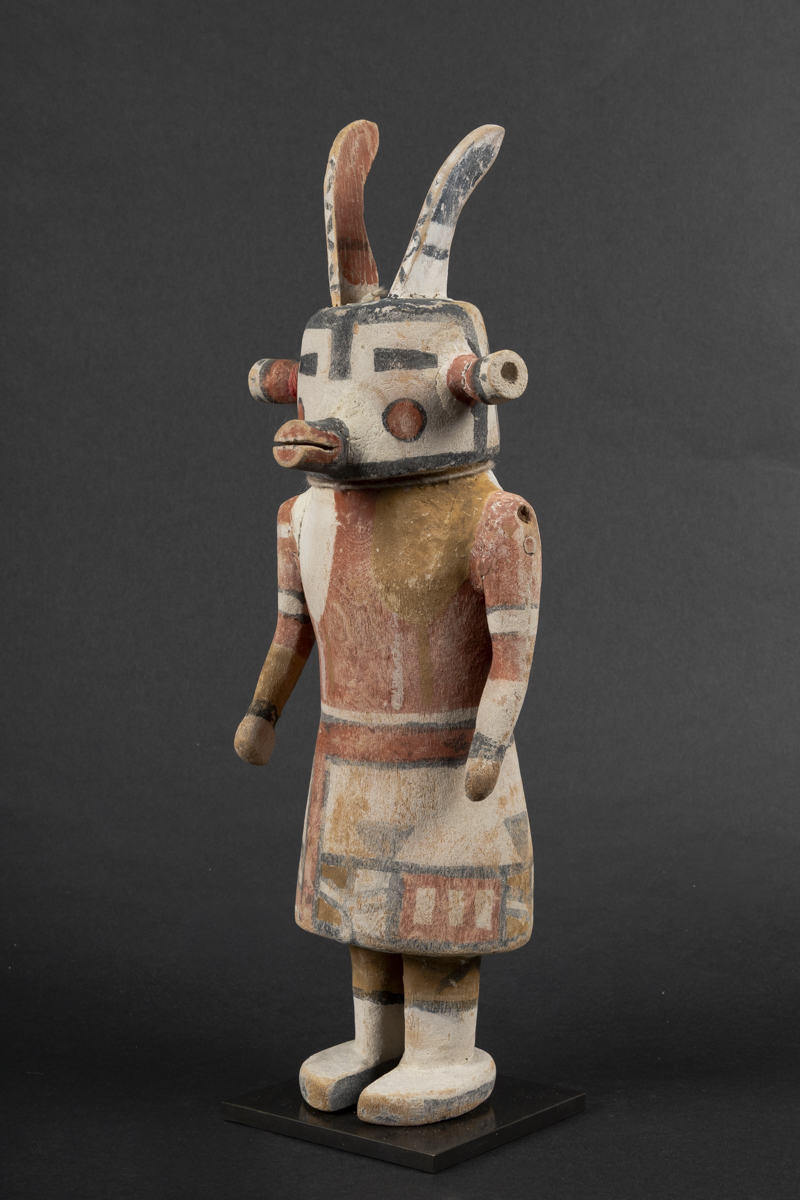
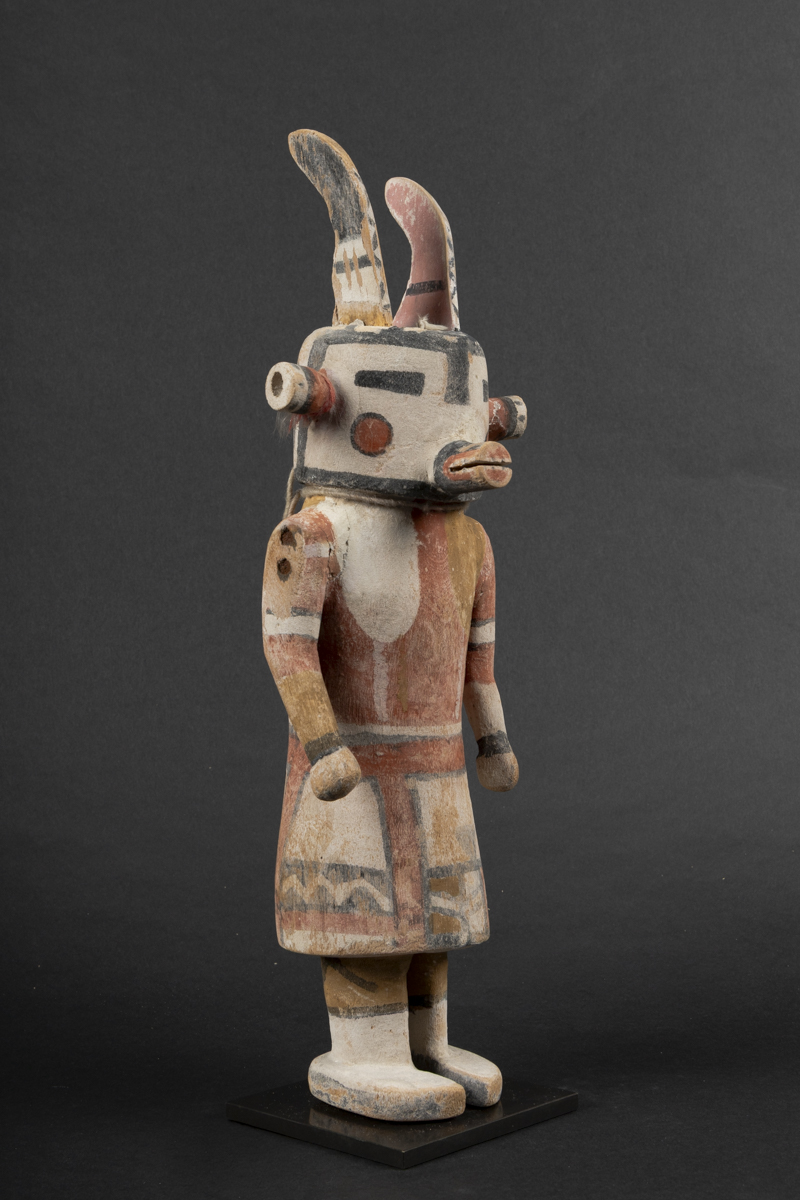
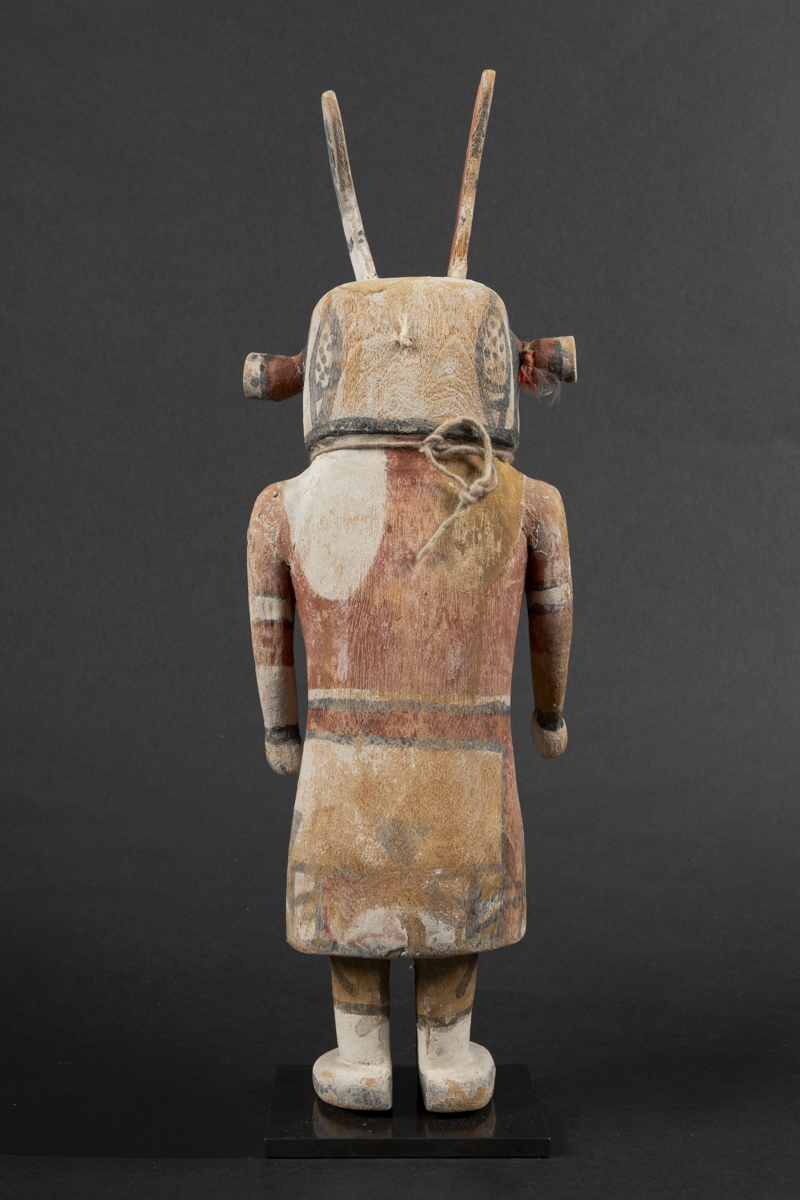
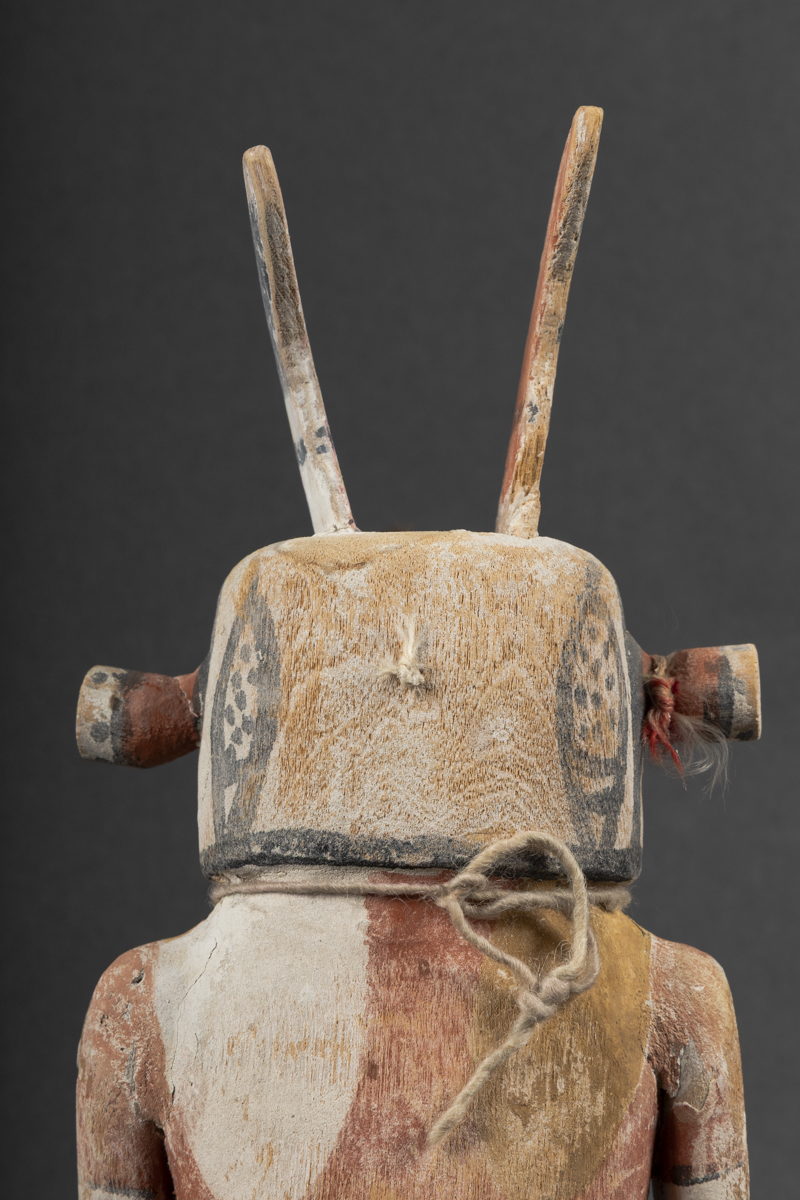
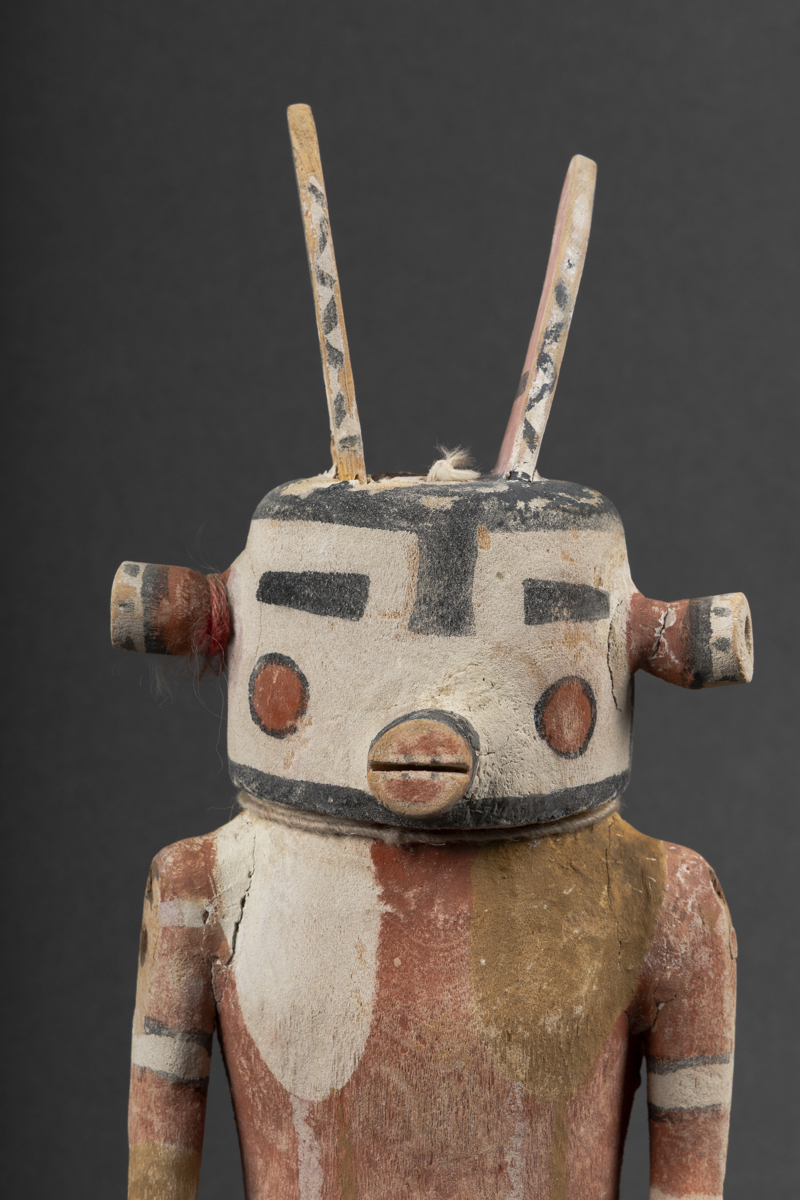
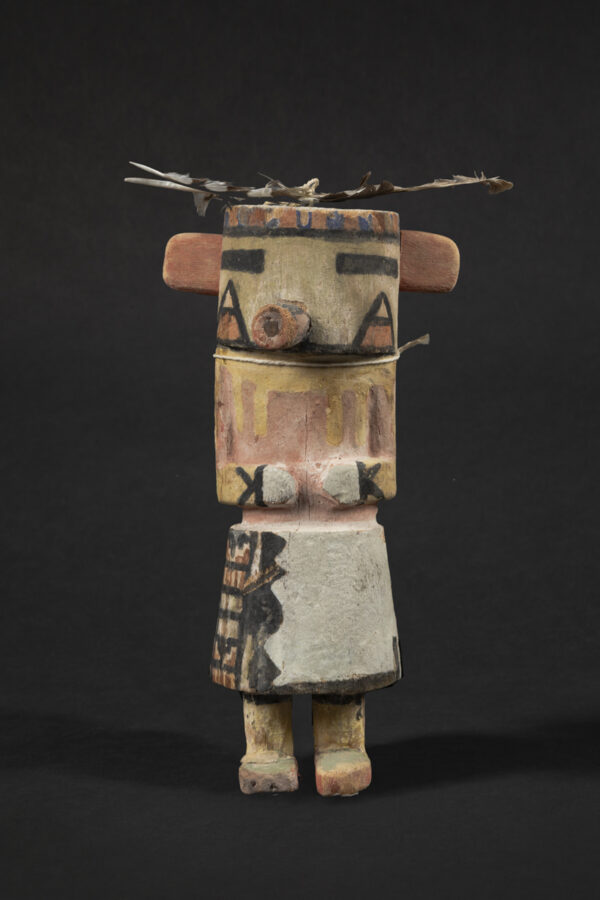
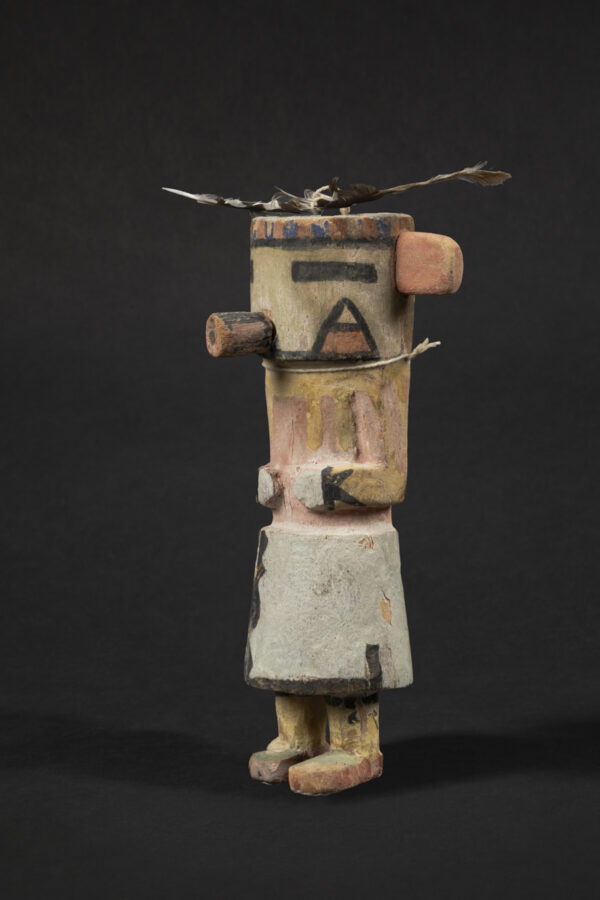
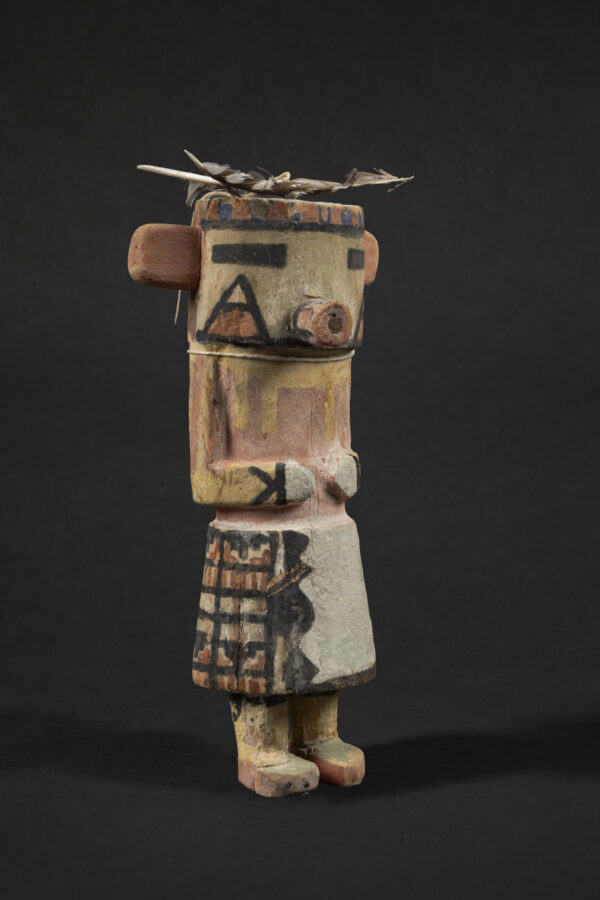
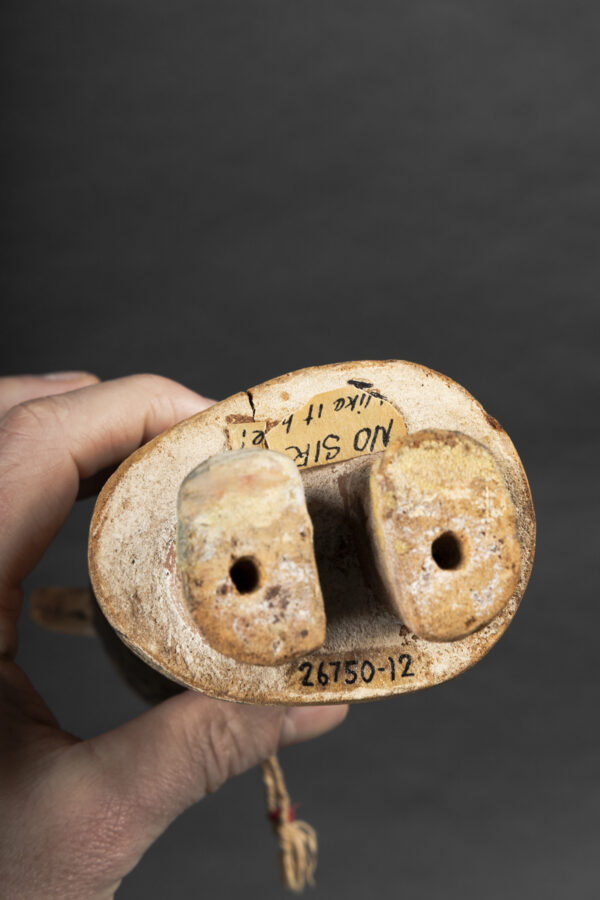
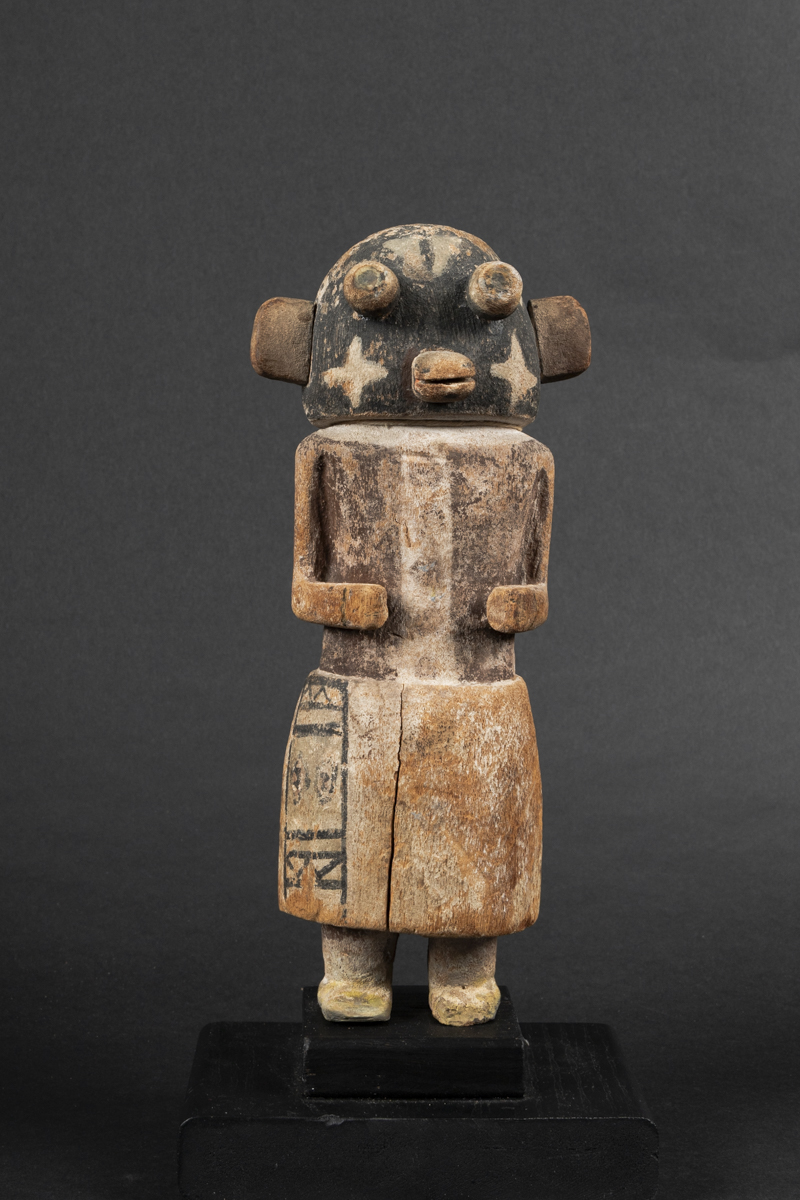
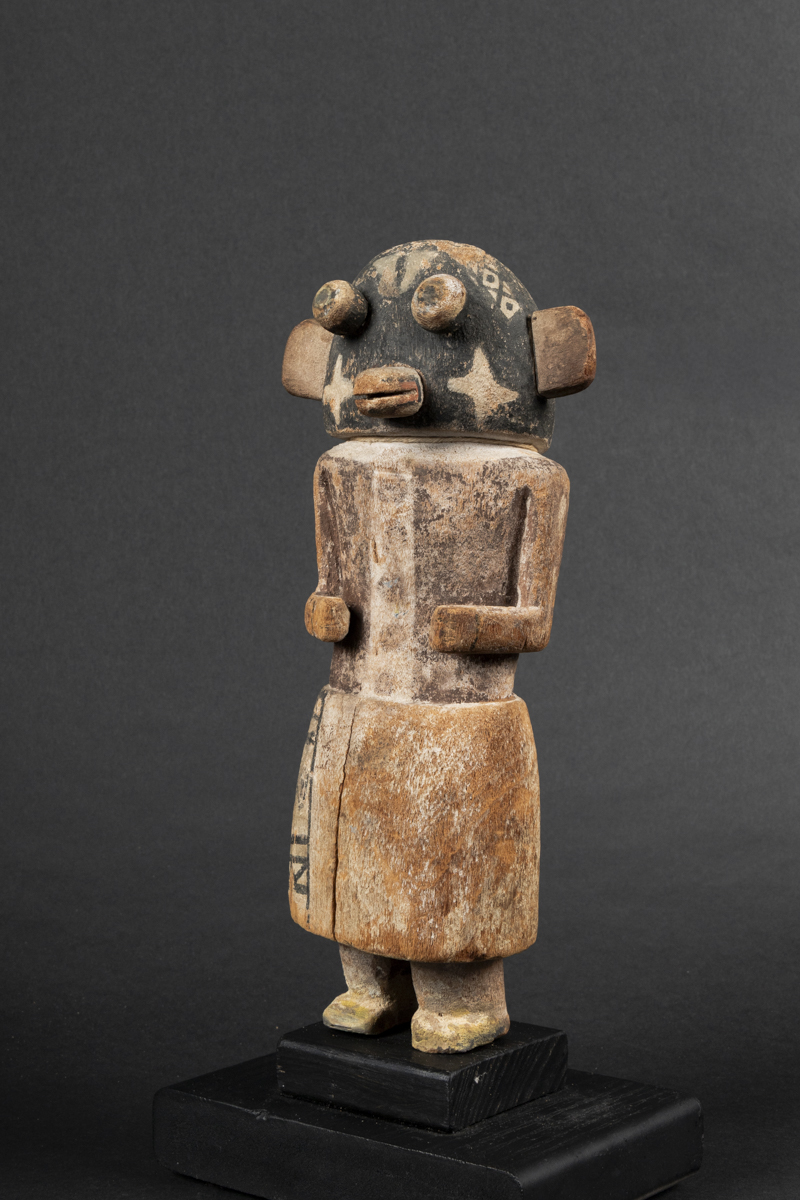
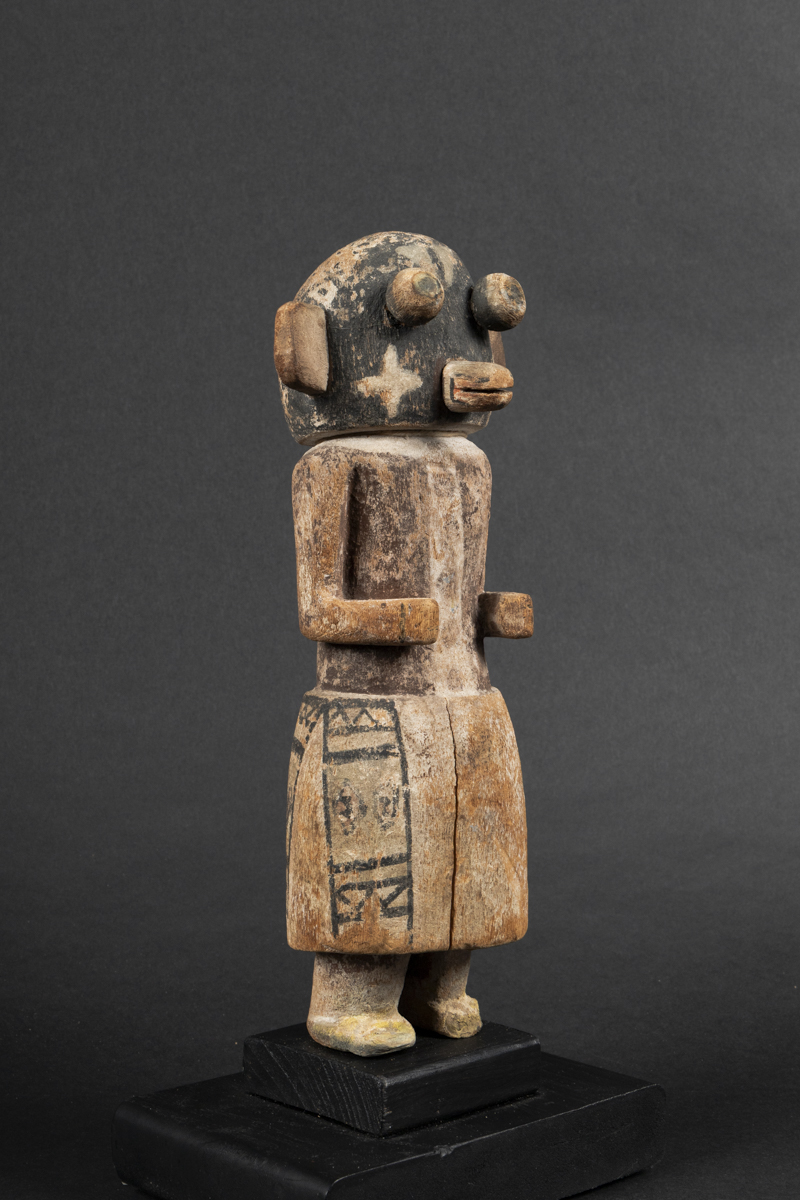
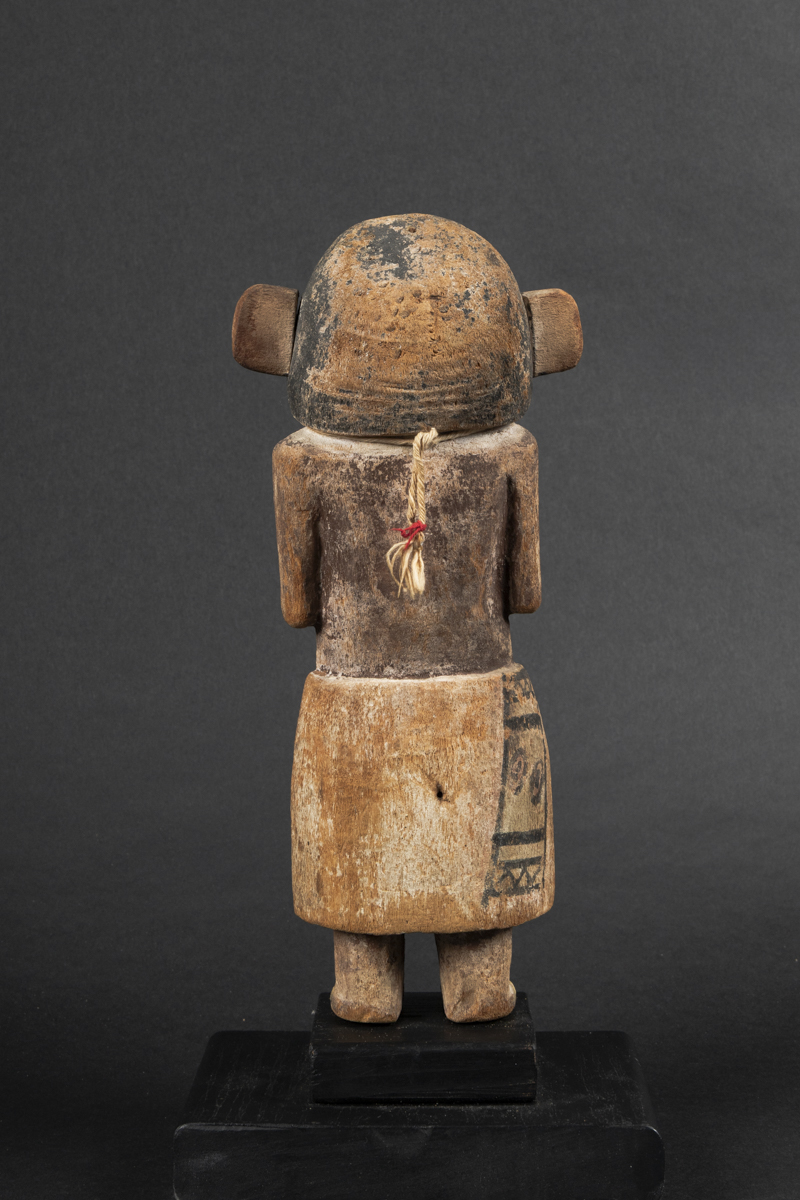
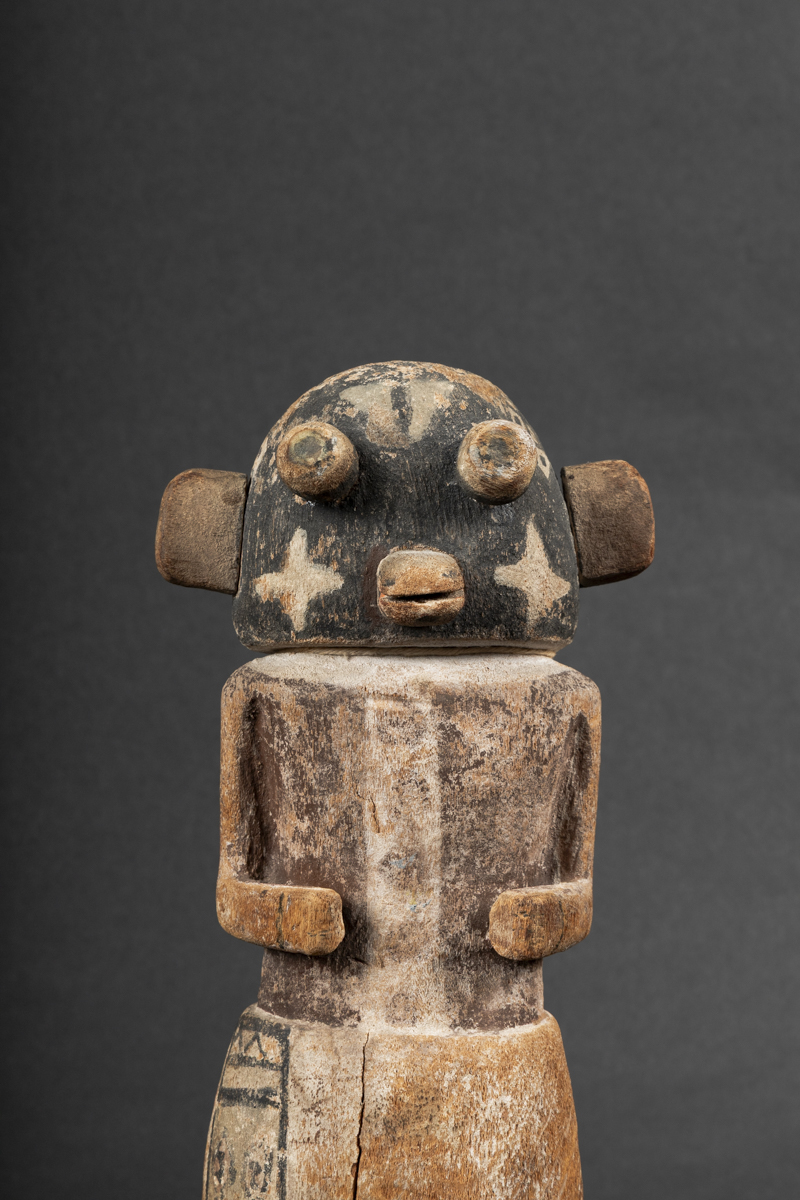
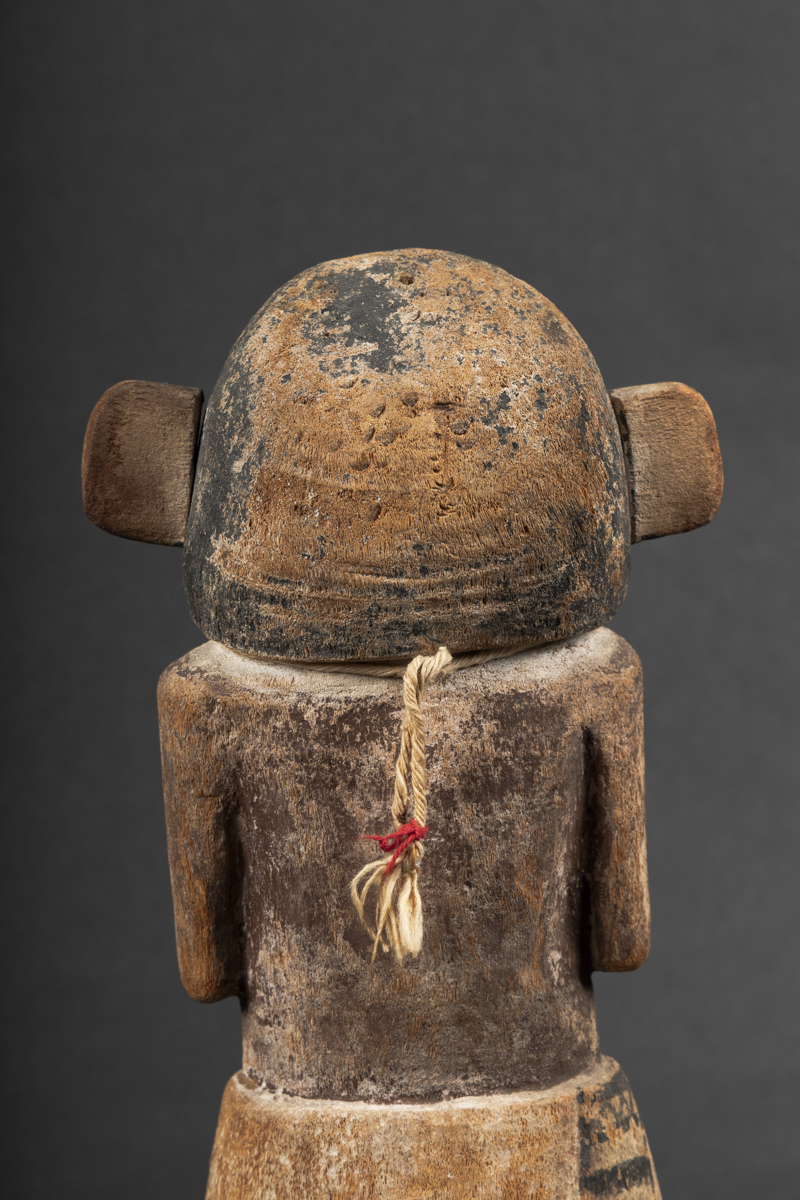
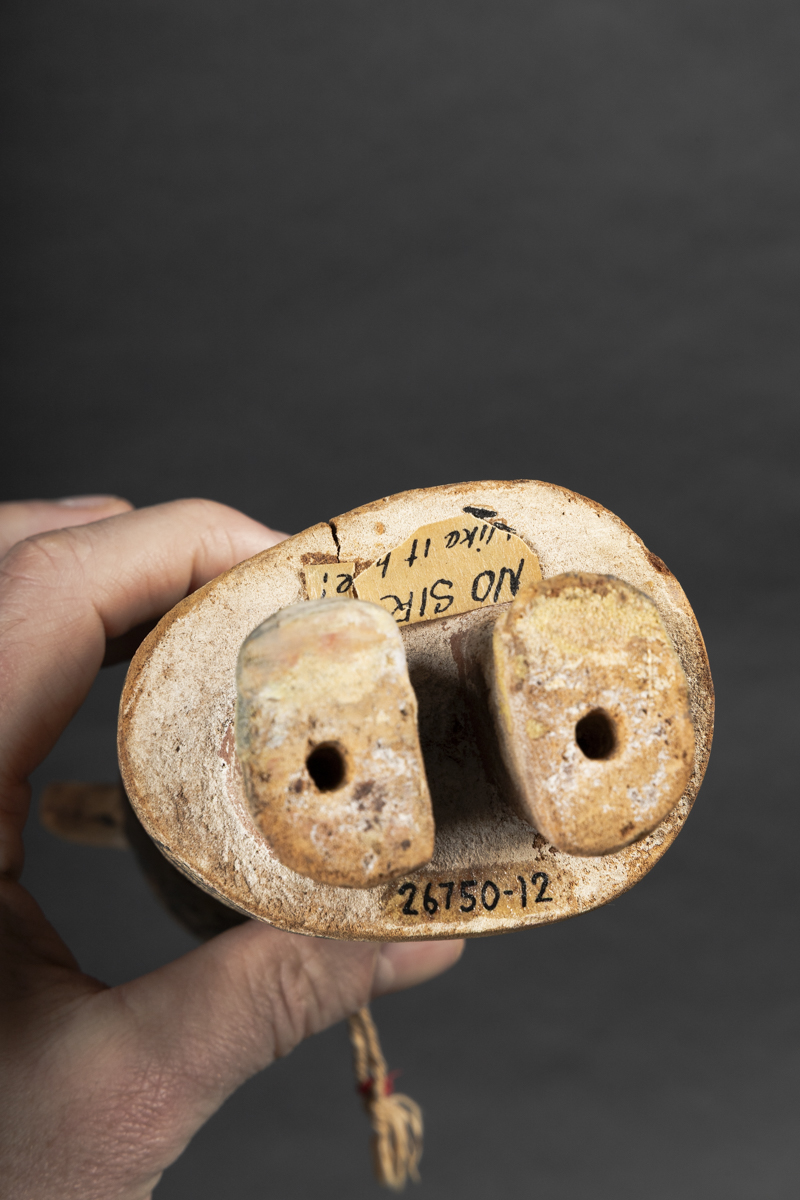
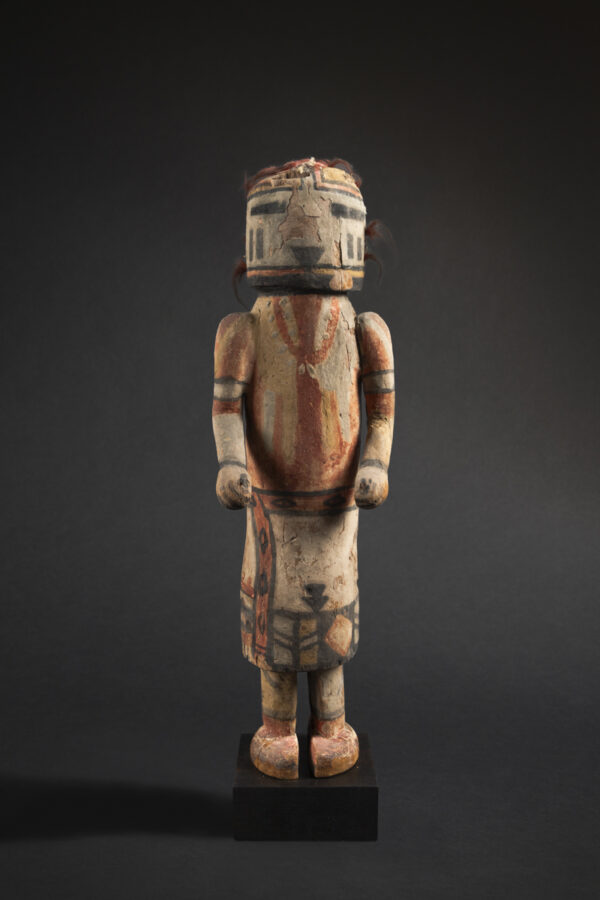
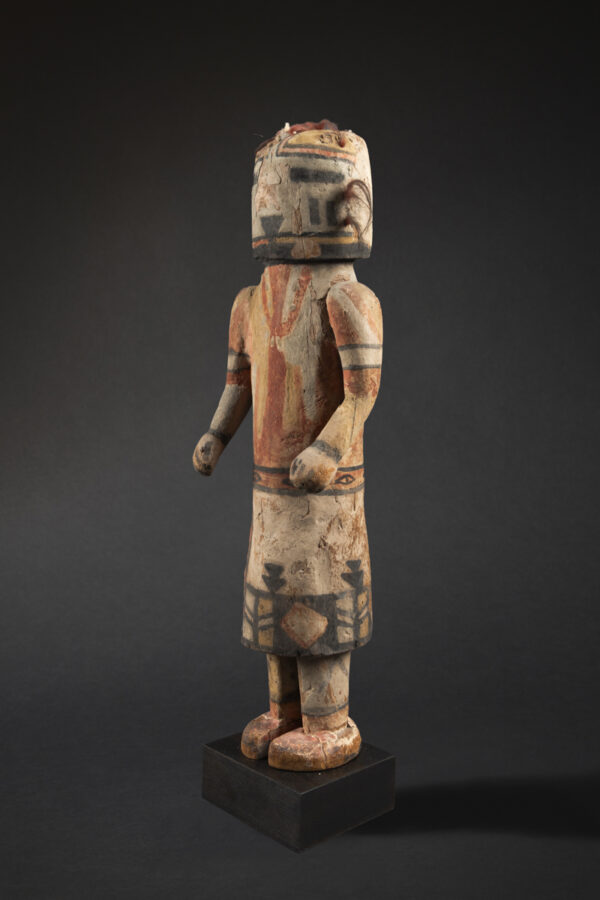
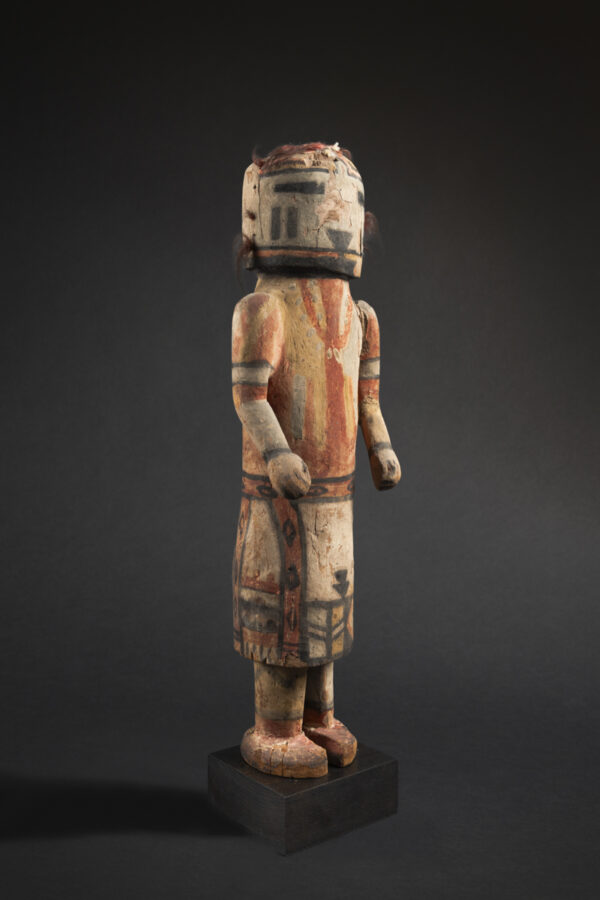
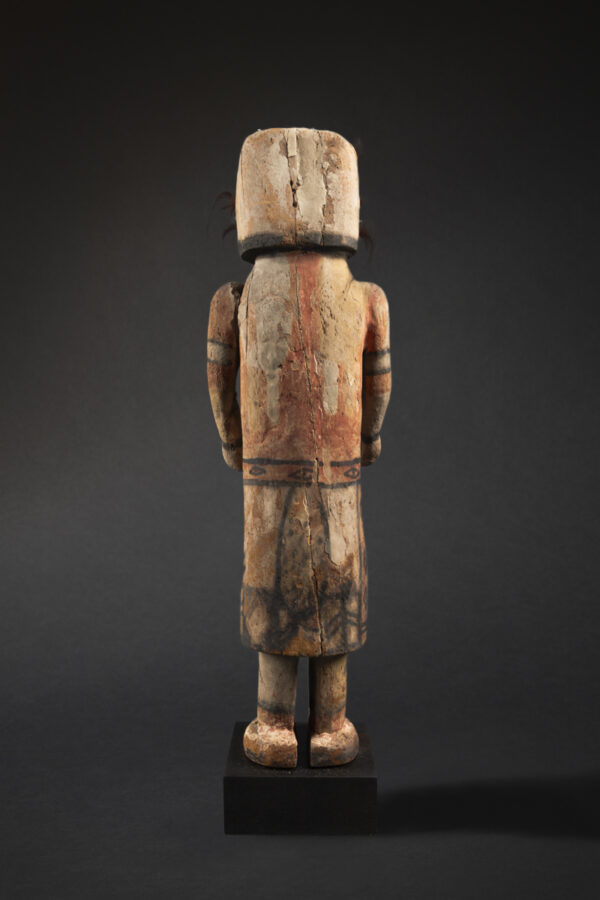
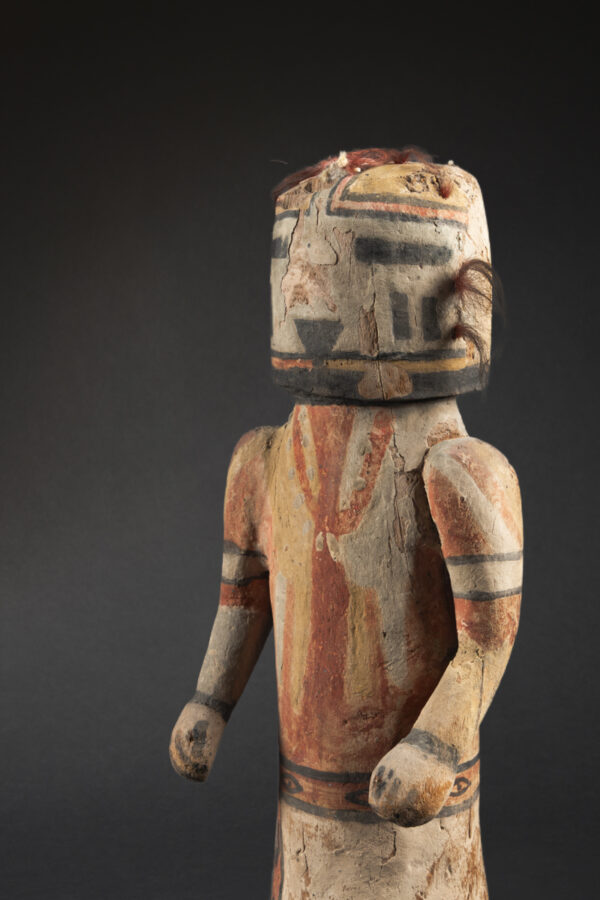
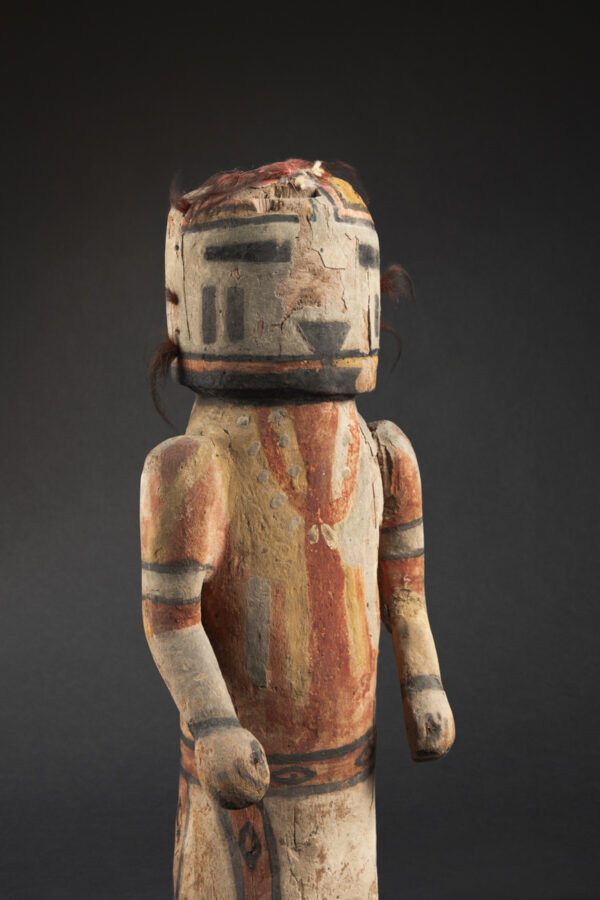
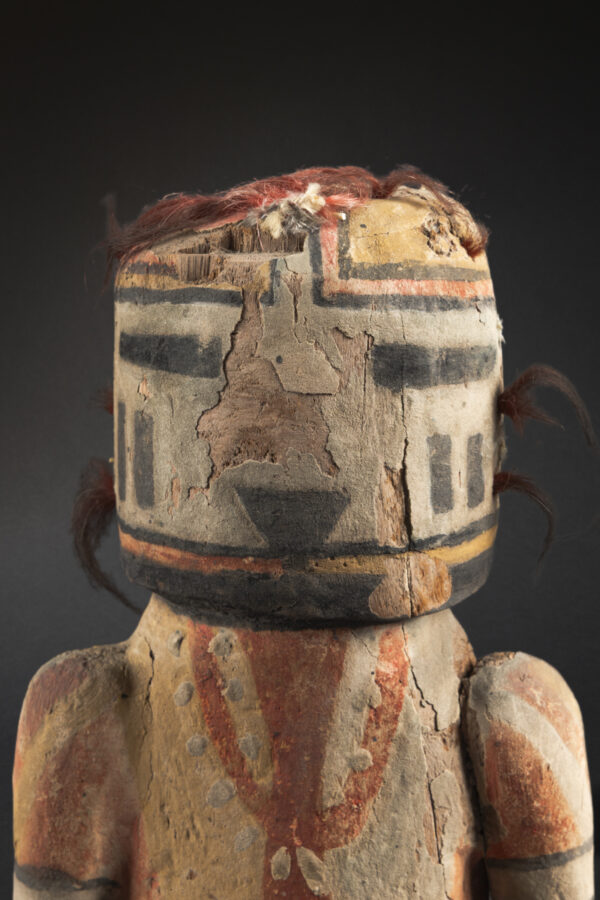
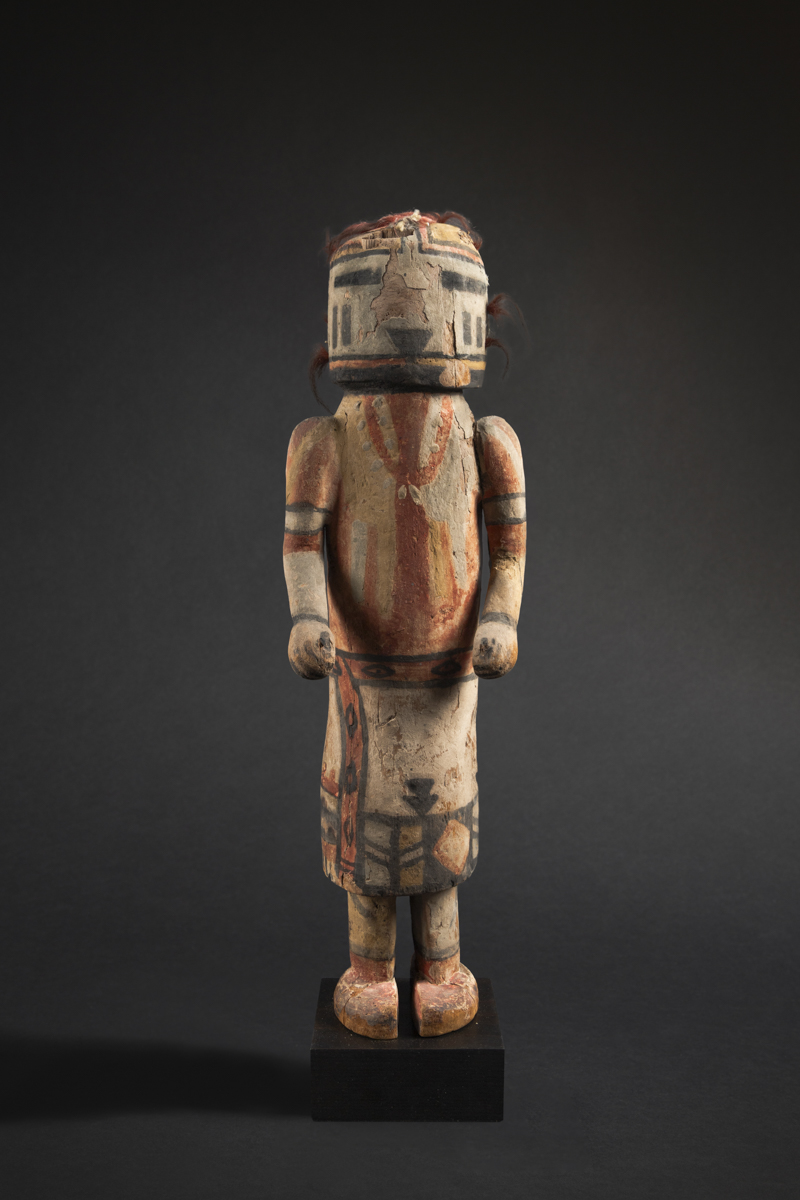
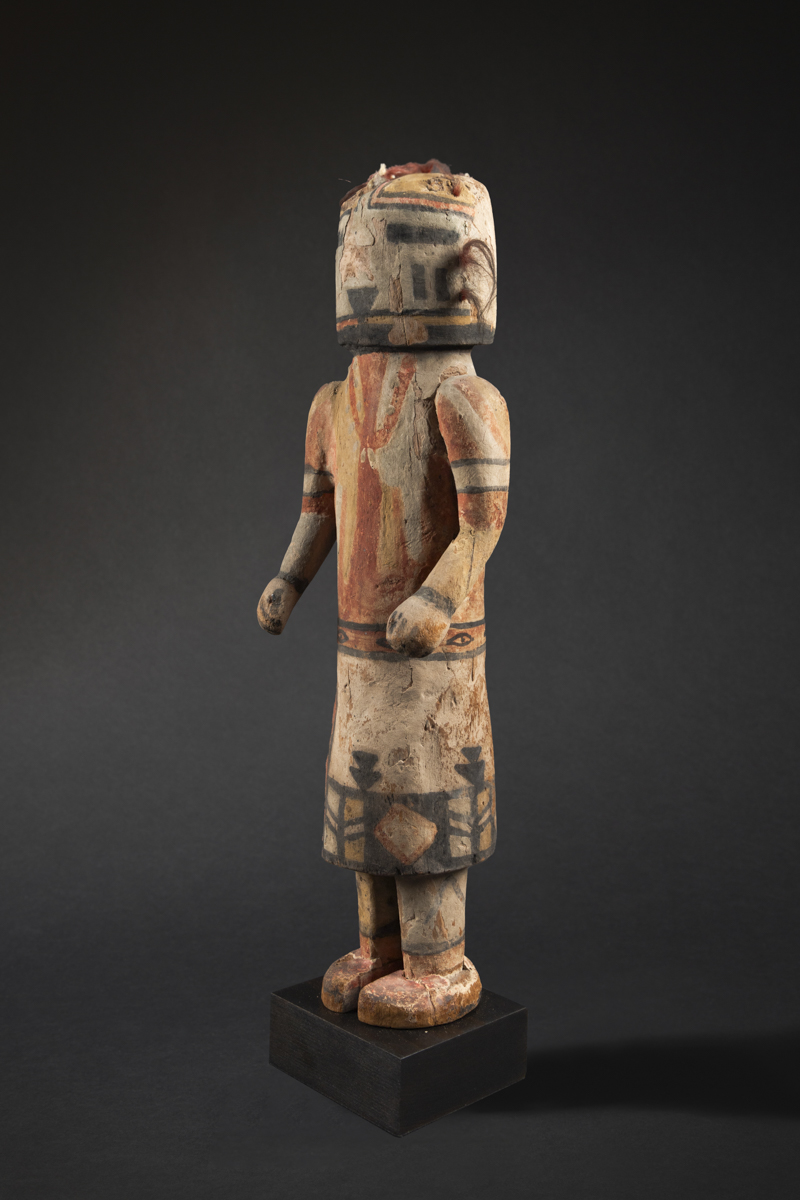
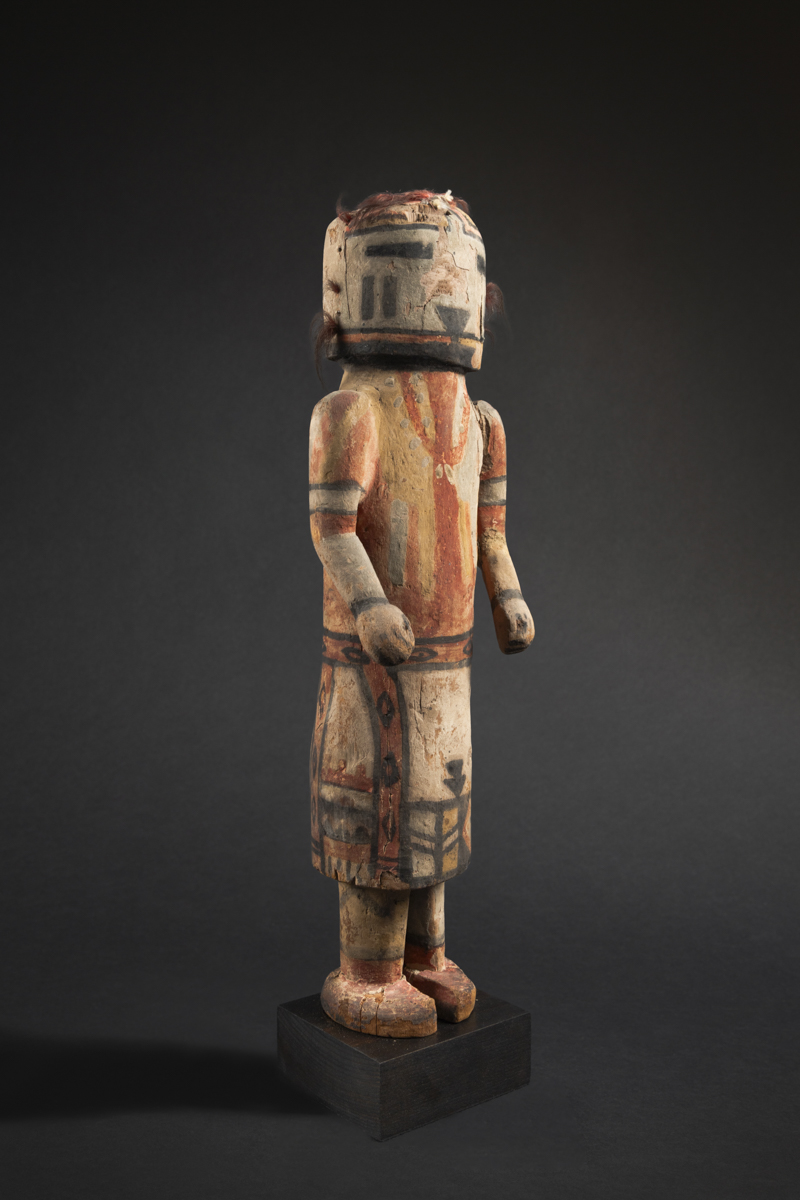
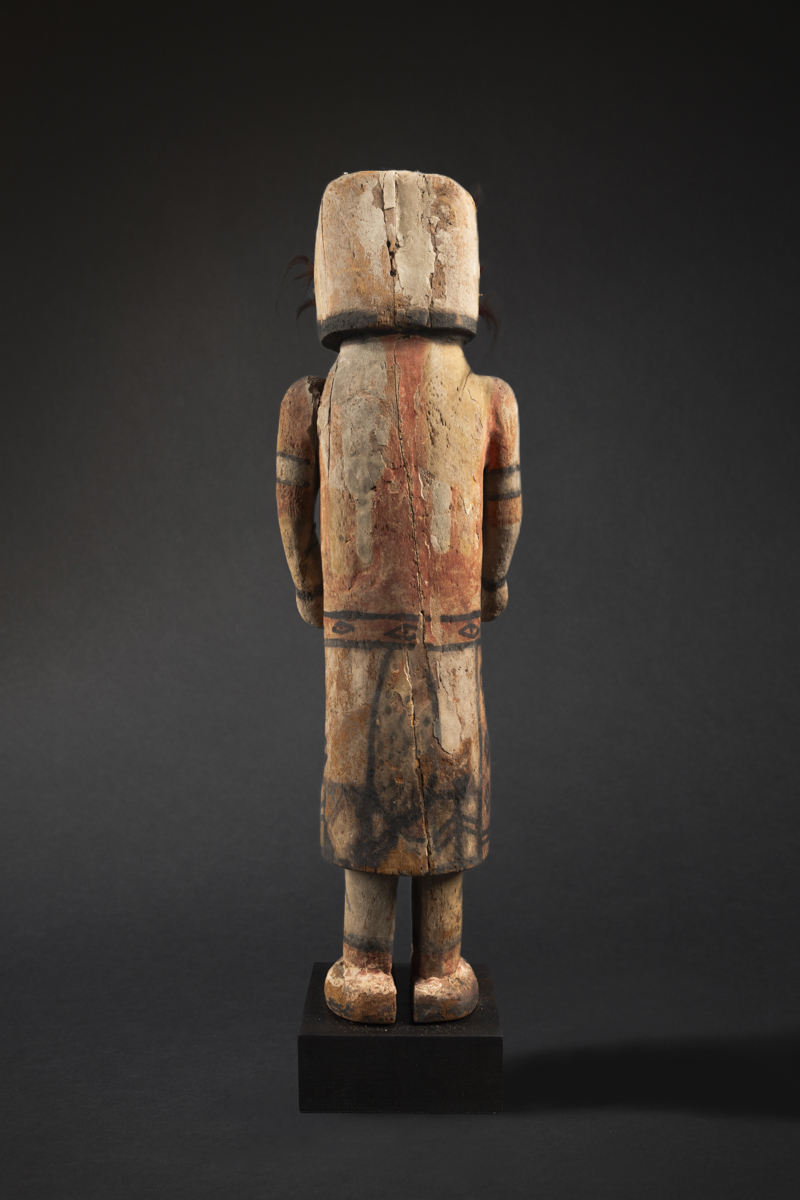
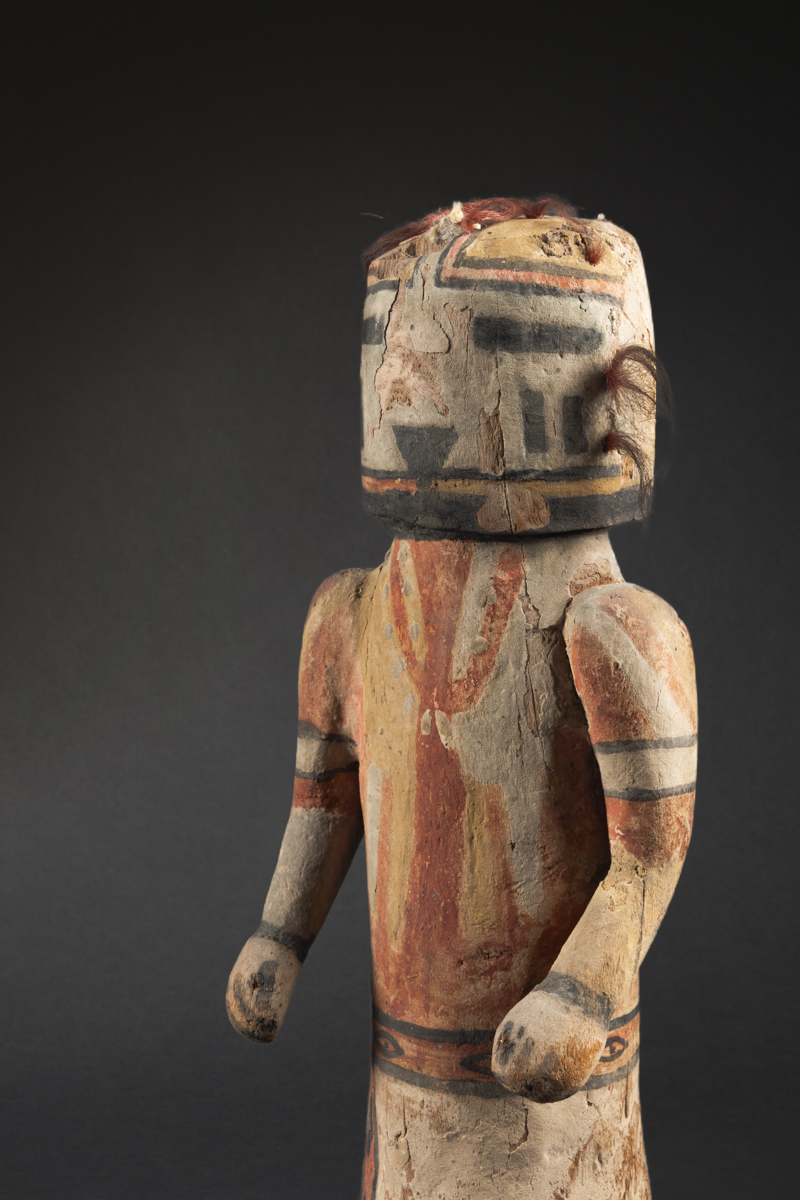
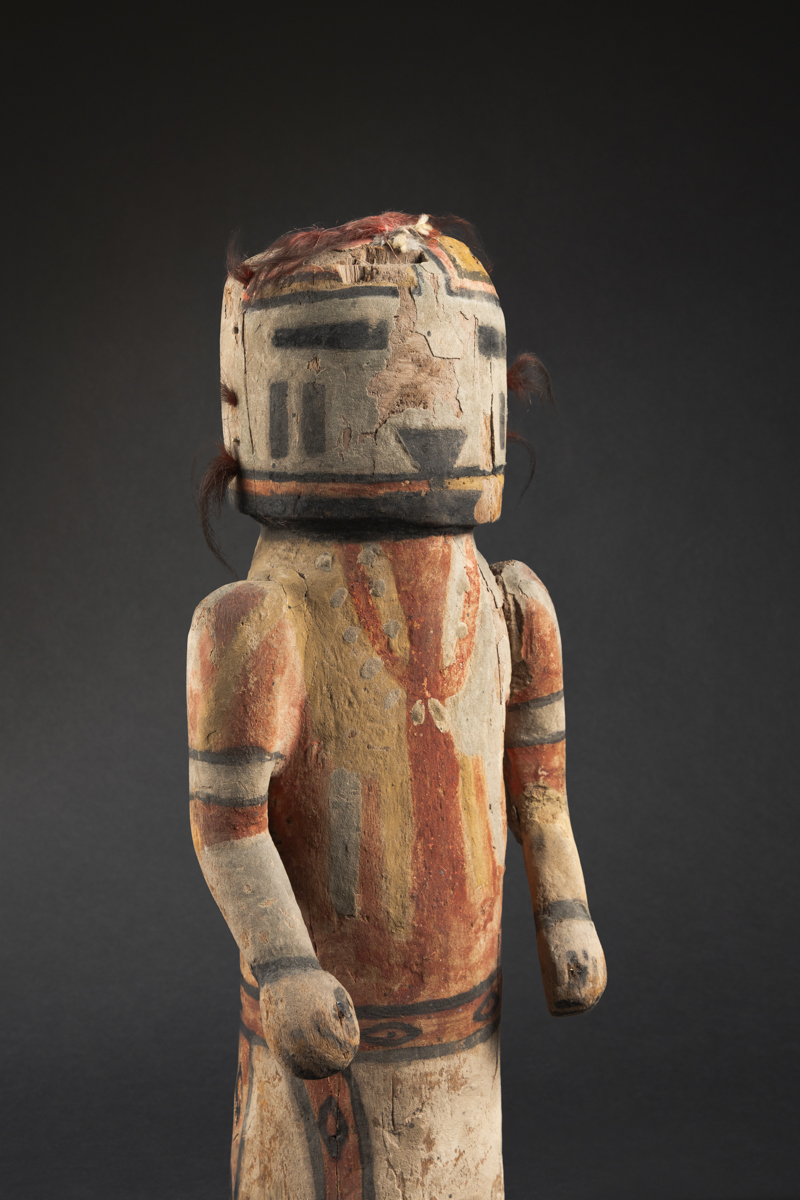
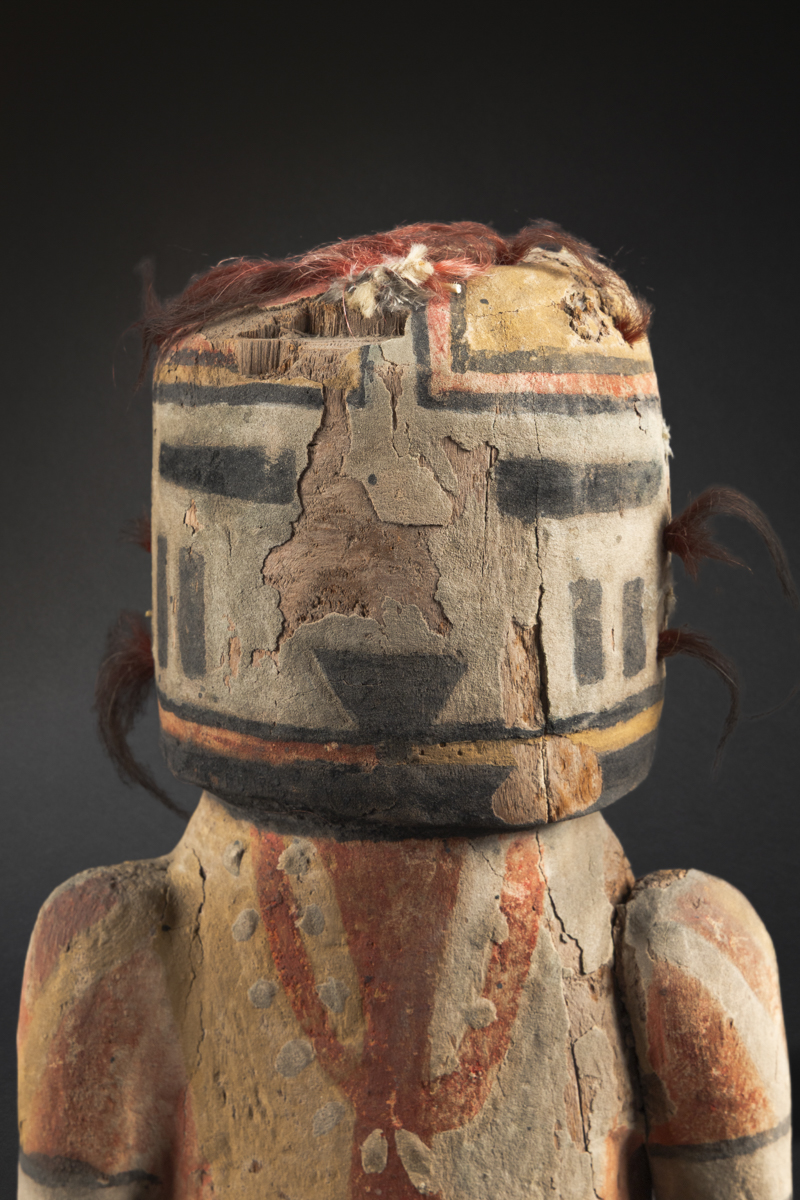
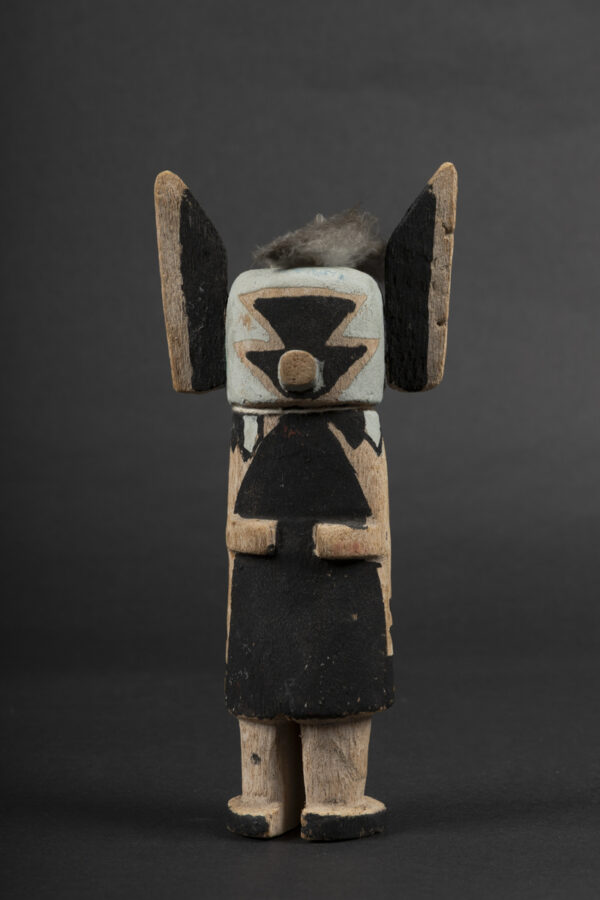
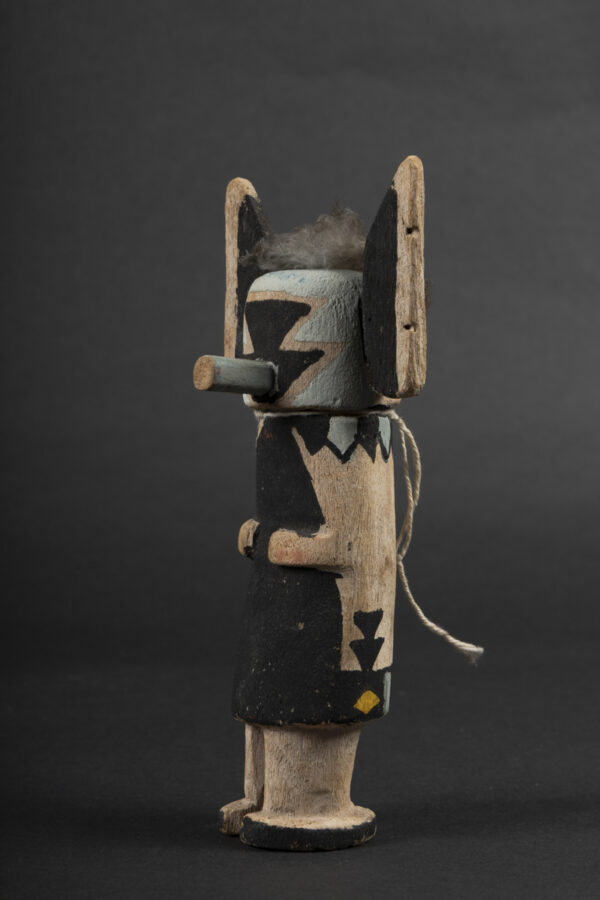
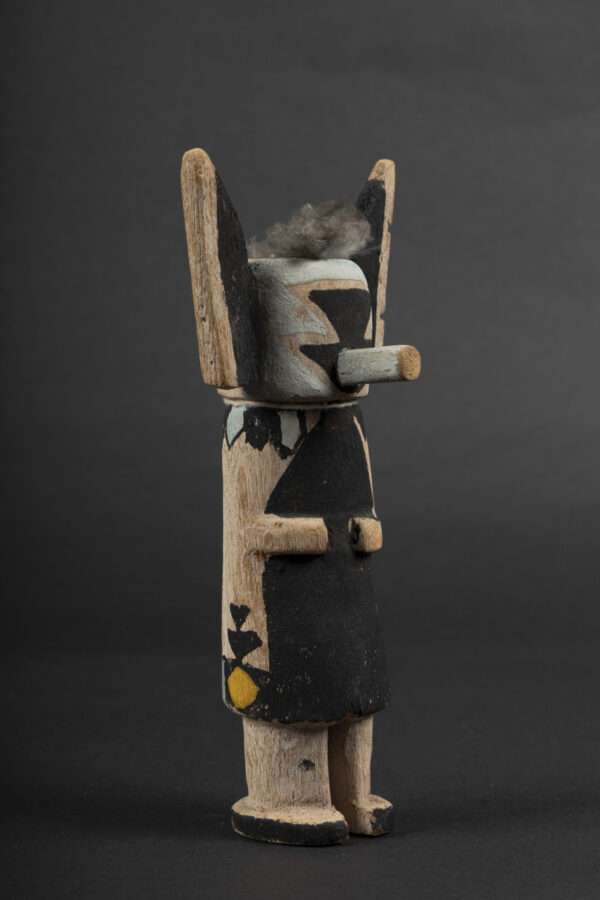
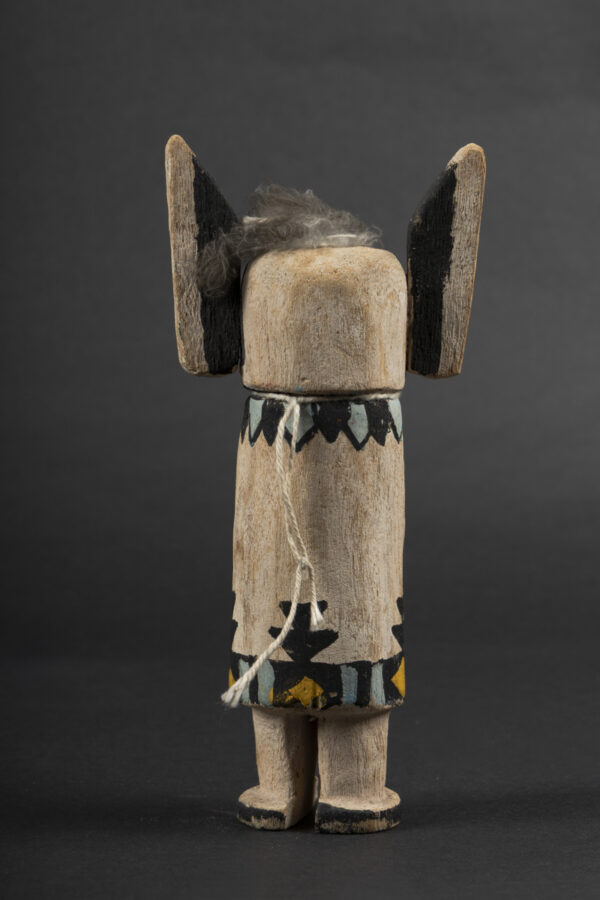
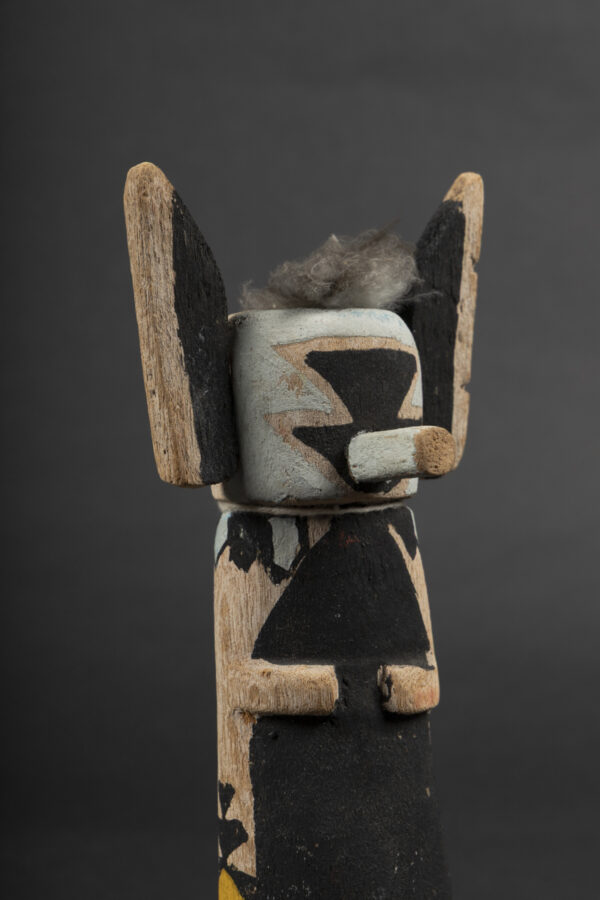
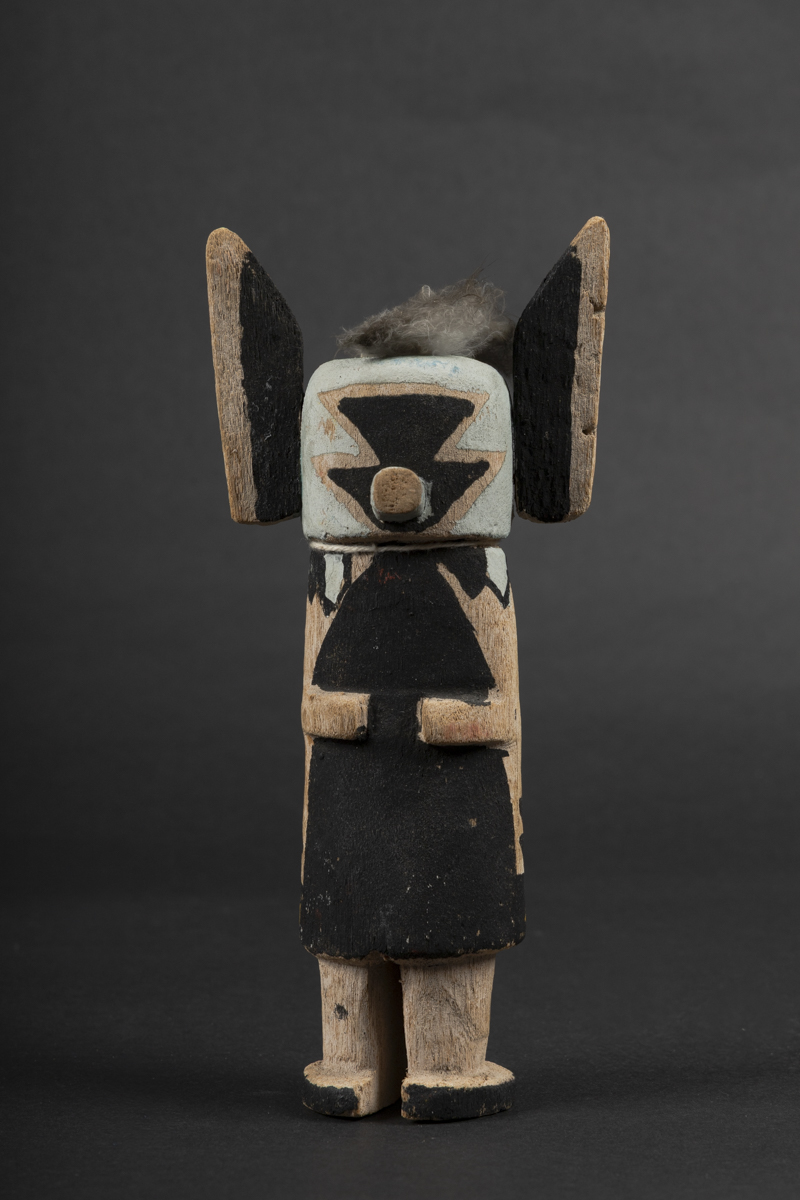
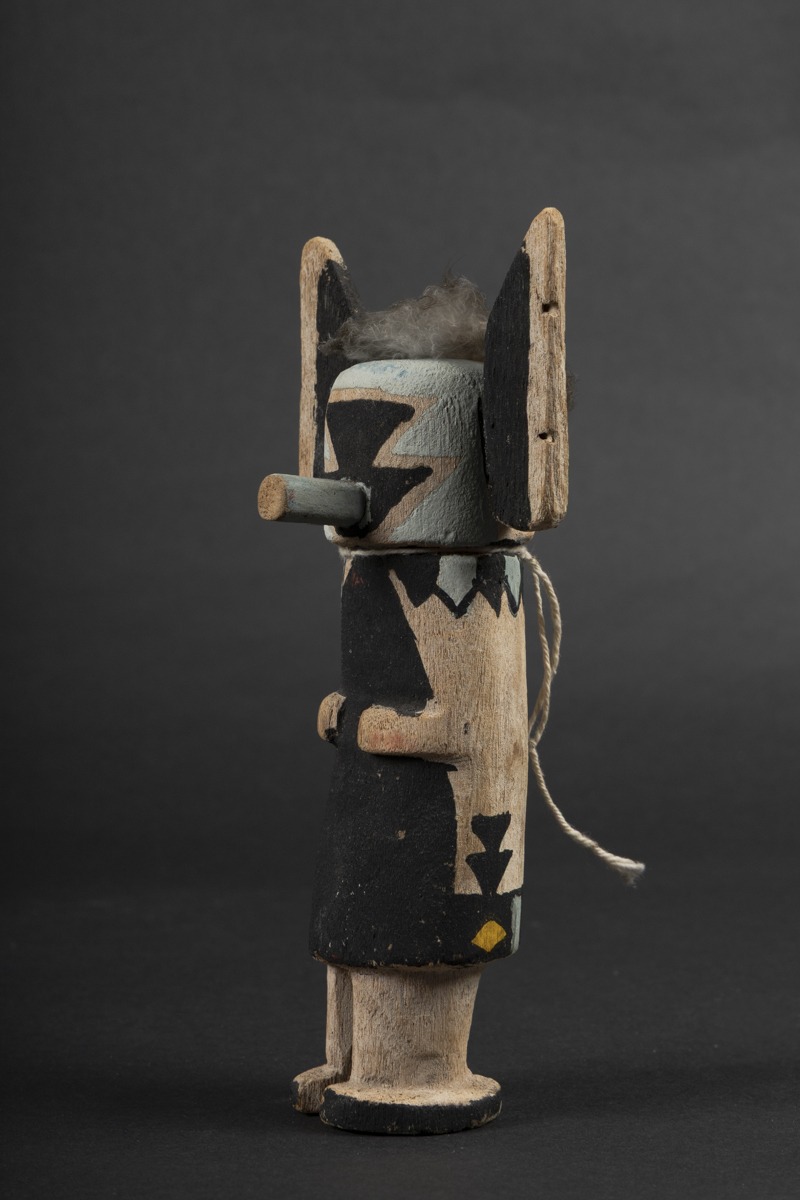
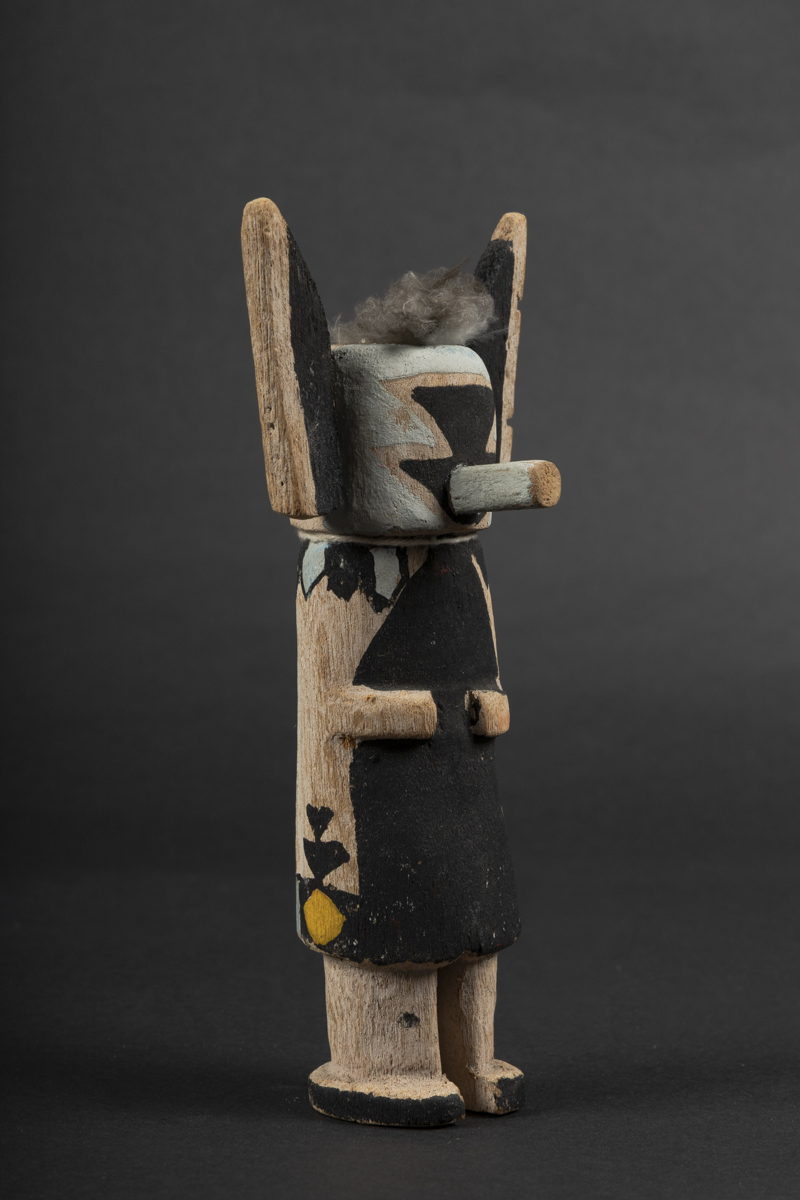
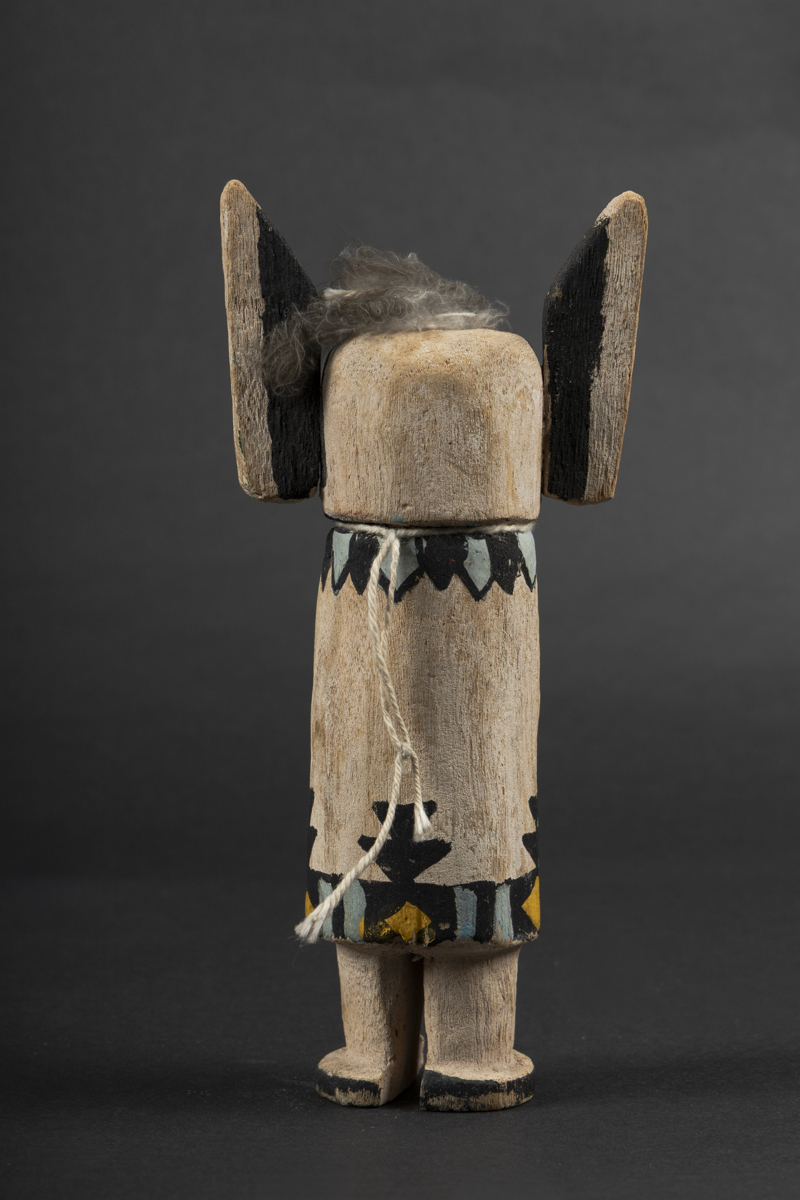
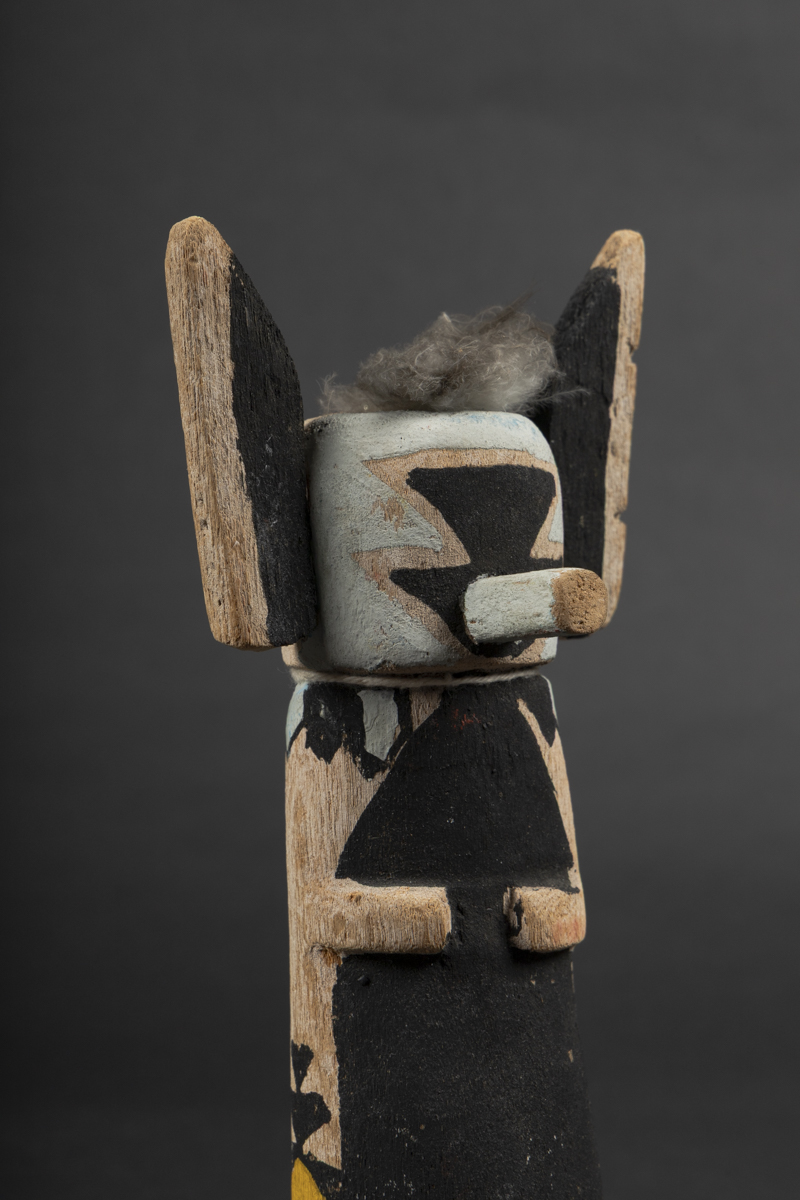
Crow Mother Katsina Doll
Angwunasomtaka
Hopi
Arizona, USA

Circa 1920
Carved wood (cottonwood) and pigments
Height: 18 cm – 7 in.

Provenance
Collection Alan Kessler, Santa Fe

Crow Mother Katsina doll 18 cm Kessler/ Galerie Flak Price: on request
Katsina dolls (or Katsinam) represent spirits or gods from the pantheon of the Pueblo peoples in the American Southwest. Given to children, kachina dolls constituted a teaching tool allowing them to familiarize themselves with the spiritual world and perpetuating knowledge of the founding myths on which their society was based.

This Katsina is named Angwusnasomtaka in the Hopi pantheon, which means "Crow Mother" or "The one with Crow Wings." On the First Mesa, she is known as Tumas.
She is considered the mother of all Katsinam. She appears on all three mesas, usually in connection with the initiation of the young Hopis. She is a Chief-Katsina and often leads the procession with a calm and imposing step. As she passes by the kivas, she calls various Katsinam to join the ceremony.

Video

Explore the entire collection
Kachina Collection
North America | Arizona
Kachina Collection | Arizona
North America | Arizona
Kachina Archives | Arizona
Discover our collections
CoLLECTIoNS

Katsina Doll

Kachina Collection | Arizona

Katsina Doll

Arizona

Antelope Katsina Doll (variant)
Chöp
Carved by Hopi Chief Wilson Tawaquaptewa (1873-1960)
Hopi
Arizona, USA

Circa 1930
Carved wood (cottonwood) and pigments
Height: 36 cm – 14 ¼ in.

Provenance
Collection Steve Nelson, California

Tawaquaptewa Antelope Katsina 36 cm / Galerie Flak Price: on request
Katsina dolls (or katsinam) represent spirits or gods from the pantheon of the Pueblo peoples in the American Southwest. Given to children, katsina dolls constituted a pedagogical tool allowing them to familiarize themselves with the spiritual world and perpetuating knowledge of the founding myths on which their society was based.

Chop Katsina danced to increase the numbers of game animals and bring rain, this Katsina is also said to enable the grass to grow and help cure spasms.
Chop dancers appeared in Mixed Dances (usully along with the Wolf Kachina/Kweo).

This Katsina doll is the work of a Hopi master carver, Wilson Tawaquaptewa (1873-1960).
Oraibi chief W. Tawaquaptewa was both a prominent a spiritual and political Hopi leader; he is also celebrated as one of the greatest Katsina doll carvers.
A major exhibition of W. Tawaquaptewa's works was notably presented a few years ago at the Birmingham Museum of Art (Alabama, USA).
The color palette on this doll is typical of this artist's works.

For more information on this artist, please refer to the chapter “The Unique Katsinam of Wilson Tawaquaptewa” in the book "L'Appel des Kachinas - Katsina Calling", pages 60 to 72 (B. Walsh, J. Flak, 2024).

Video

Explore the entire collection
Kachina Collection
North America | Arizona
Kachina Collection | Arizona
North America | Arizona
Kachina Archives | Arizona
Discover our collections
CoLLECTIoNS

Katsina Doll

Kachina Collection | Arizona

Katsina Doll

Arizona

Corn Dancer Katsina Doll
Ka’e
Hopi
Arizona, USA

Circa 1900-1920
Carved wood (cottonwood) and pigments
Height: 19 cm – 7 ½ in.

Provenance
Kania-Ferrin Gallery, Santa Fe
Private collection, USA

Publication
«Hopi Katsina, 1600 artists biographies»,
Gregory Schaaf, 2008, p. 14

Kae Katsina doll Kania Ferrin / Galerie Flak Price: on request
Katsina dolls (or Katsinam) represent spirits or gods from the pantheon of the Pueblo peoples in the American Southwest. Given to children, Katsina dolls constituted a teaching tool allowing them to familiarize themselves with the spiritual world and perpetuating knowledge of the founding myths on which their society was based.

A member of the Flora Katsinam (Kachina Tusak), Ka’e is one of the many Katsinam associated with maize. Ka’e is particularly cherished by the Hopi for her songs, choreography, and the vital role she played during her appearances. Present at almost every Katsina dance, she invoked the elements to ensure abundant corn harvests.
Plants hold fundamental importance for the Hopi, whose food resources are limited. Accordingly, many Katsinam in the pantheon reference vegetation, and particularly maize, which is the primary source of sustenance for Indigenous peoples of the American Southwest.
The doll presented here stands out for its exquisite color composition and the harmonious balance of its construction.

Video

Explore the entire collection
Kachina Collection
North America | Arizona
Kachina Collection | Arizona
North America | Arizona
Kachina Archives | Arizona
Discover our collections
CoLLECTIoNS

Katsina Doll

Preview | Arizona

Katsina Doll

Arizona

Star Katsina Doll
Sohu Ho’ote
Hopi
Arizona, USA

Circa 1890 – 1900
Carved wood (cottonwood) and natural pigments
Height: 24.5 cm – 9 ½ in.

Provenance
Collection Lilian & Albert T. Miller, 49 Steps Gallery, Los Angeles in the 1960s
By descent in the Miller family
Collection Gary Spratt, San Francisco Bay Area, California, acquired from the above

Exhibition & Publication
« Kachinas », Otis Art Institute of Los Angeles County 13 April – 14 May 1967

Sohu Ho’ote Katsina doll 24.5 cm / Galerie Flak Price on request
Katsina dolls (or katsinam) represent spirits or gods from the pantheon of the Pueblo peoples in the American Southwest. Given to children, Katsina dolls constituted a teaching tool allowing them to familiarize themselves with the spiritual world and perpetuating knowledge of the founding myths on which their society was based.

Ho'ote Katsina is considered particularly beneficial by the Hopi. He is said to bring good fortune to the members of the kiva and to the entire village. Despite the horns and the fearsome appearance, he is a kindly Katsina.
He is danced on all the mesas and can also be seen in the Niman ceremony. His appearances are prayers for the blooming of spring flowers. He acts as a messenger and ensures the harmony of the elements, notably the stars and the sun.
The motifs on his face depict a stylized rainbow and multicolored raindrops, symbolizing the cardinal directions from which they originate.

Video

Explore the entire collection
Preview
Preview | Arizona
Preview | Arizona
Preview | Arizona
Preview | Arizona
Preview | Arizona
Preview | Arizona
Preview | Arizona
Preview | Arizona
Preview | Arizona
Preview | Arizona
Preview | Arizona
Preview | Arizona
Preview | Arizona
Kachina Collection | Arizona
Preview | Arizona
Kachina Collection | Arizona
North America | Arizona
Discover our collections
CoLLECTIoNS

Kachina doll

Kachina Collection | Arizona

Kachina doll

Arizona

Umtoinaqa Katsina – Making Thunder Katsina doll
Carved by Hopi Chief Wilson Tawaquaptewa Oraibi (1873-1960)
Hopi, Arizona, USA

Circa 1930
Carved wood (cottonwood), pigments
Height: 47.5 cm – 18 ¾ in.

Provenance
Collection Enrico Donati (1909-2008), New York
Sotheby’s New York « Important American Indian, African, Oceanic and other Works of Art from the Studio of Enrico Donati », 14 May 2010, lot 6
Collection Sheikh Saud Al-Thani, Qatar, acquired at the above auction

Exhibition and Publication
“The Surreal World of Enrico Donati », Timothy Anglin Burgard, Fine Arts Museum of San Francisco, de Young Museum, June-September 2007, p. 53.

Published: "Vis-a-Vis", September 2025
Making Thunder Katsina doll Tawaquaptewa Donati 47.5 cm / Galerie Flak Price: on request
Katsina dolls (or katsinam) represent spirits or gods from the pantheon of the Pueblo peoples in the American Southwest. Given to children, katsina dolls constituted a pedagogical tool allowing them to familiarize themselves with the spiritual world and perpetuating knowledge of the founding myths on which their society was based.
This Katsina doll is the work of a Hopi master carver, Wilson Tawaquaptewa (1873-1960).
Oraibi chief W. Tawaquaptewa was both a prominent a spiritual and political Hopi leader; he is also celebrated as one of the greatest Katsina doll carvers.
A major exhibition of W. Tawaquaptewa's works was notably presented a few years ago at the Birmingham Museum of Art (Alabama, USA).
The color palette on this doll is typical of this artist's works.

For more information on this artist, please refer to the chapter “The Unique Katsinam of Wilson Tawaquaptewa” in the book "L'Appel des Kachinas - Katsina Calling", pages 60 to 72 (B. Walsh, J. Flak, 2024).

This Katsina doll was one of the highlights of the collection of the artist Enrico Donati (1909–2008), a prominent figure of the Surrealist movement. Of Italian origin, Donati first trained in sociology and music before turning to painting. After settling in Paris and later in New York, he joined the close circle of André Breton and other major Surrealist figures, bringing new vitality to the movement with works imbued with mystery and organic forms.

In the 1930s, Donati developed a genuine passion for Native American art. Fascinated by ritual objects and the magical dimension of Indigenous creations, he visited Indian reservations in the American Southwest and northern Canada, spending several months among the Apache, Hopi, Zuni, and Inuit. During these stays, Donati exchanged European objects for Katsina figures, baskets, and masks, building a rich collection that left a lasting mark on his imagination.
This immersion did not lead Donati to a formal imitation of Native aesthetics, but rather to an embrace of a “primal” and magical spirit. Through matter and texture, he sought to reveal what lies beyond the visible. For him, Native American art acted as a catalyst of mysterious forces—an approach he strove to transpose into his own Surrealist works, where myths, enigmas, and symbols are in constant dialogue with the unknown.
For further insight into the importance of Native American art for Enrico Donati, see Marie Mauzé’s chapter “Surrealism and Hopimania” in L’Appel des Kachinas – Katsina Calling (Éditions l’Enfance de l’Art, 2024).

Publication

Video

Explore the entire collection
Kachina Collection
North America | Arizona
Kachina Collection | Arizona
North America | Arizona
Kachina Archives | Arizona
Discover our collections
CoLLECTIoNS

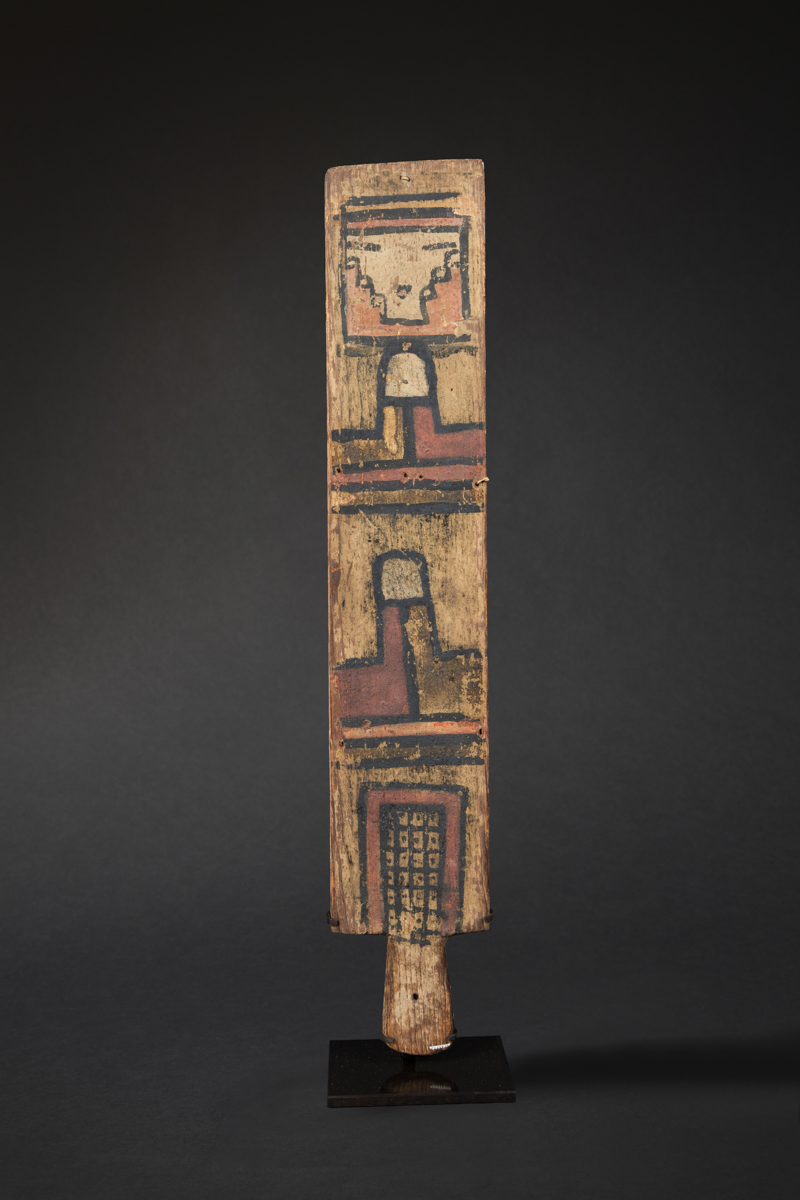
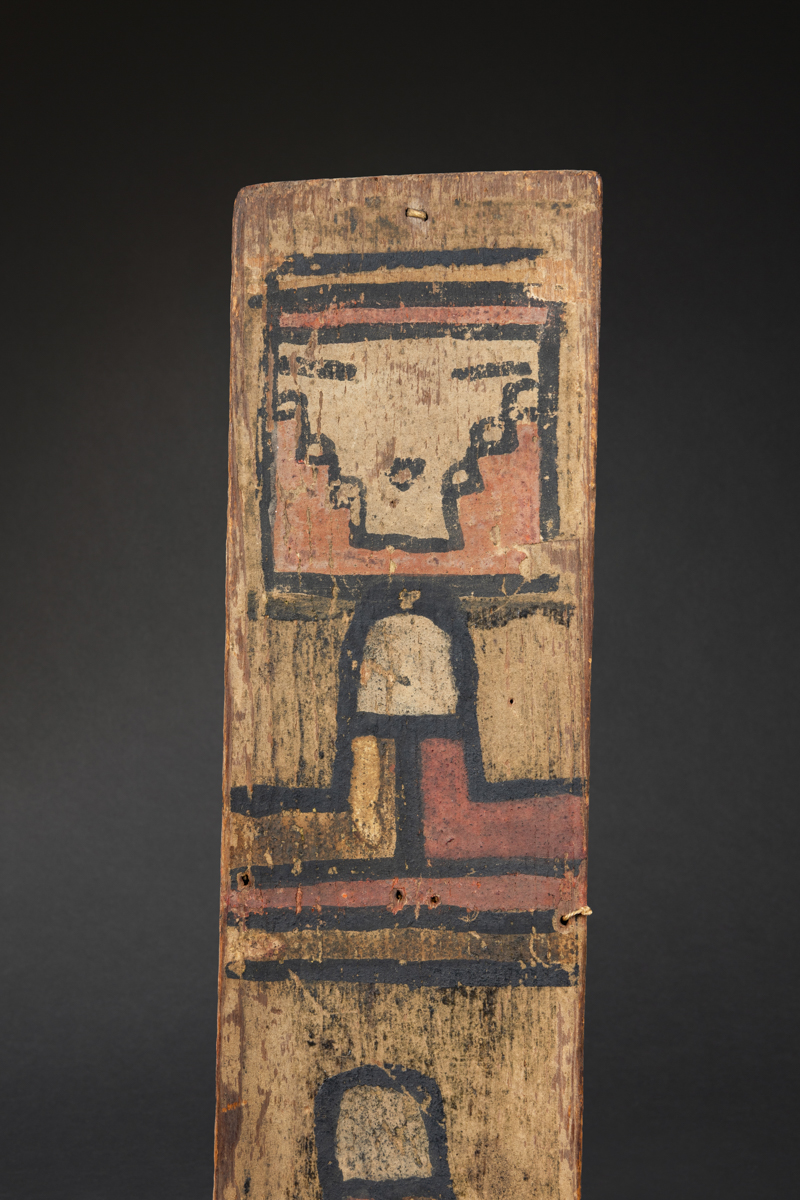
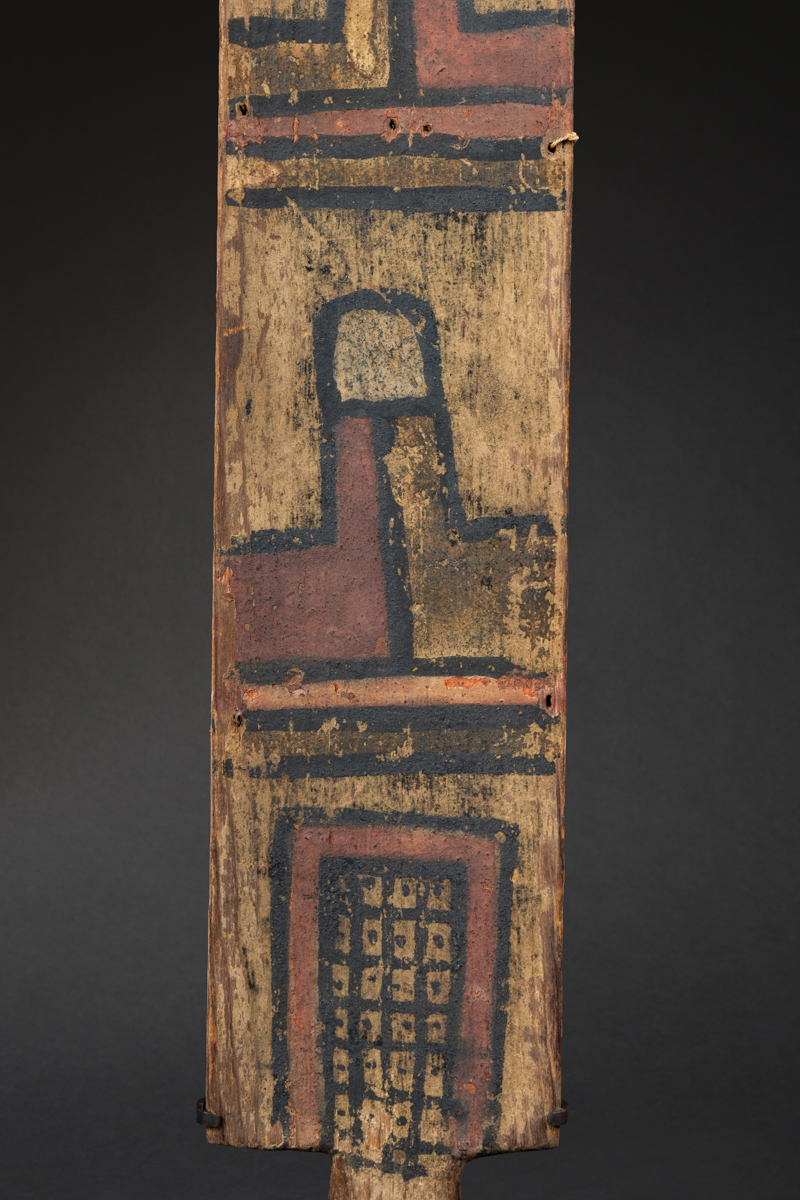
Hopi Dance Wand

Kachina Collection | Arizona

Hopi Dance Wand

Arizona

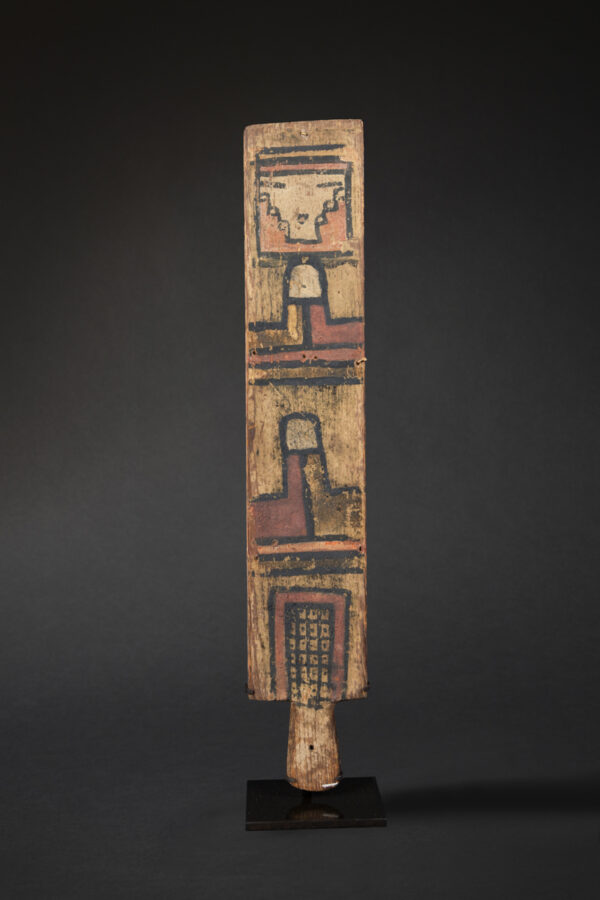
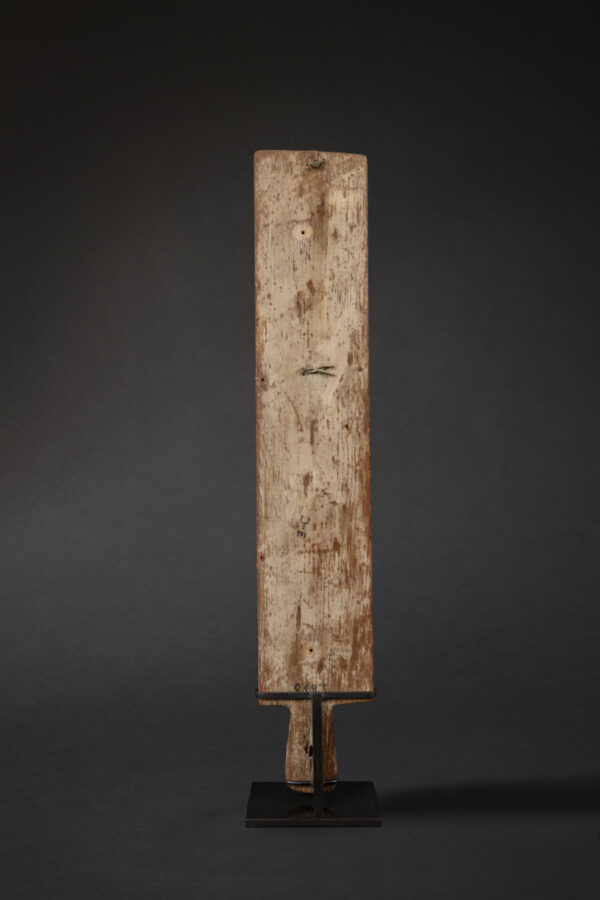
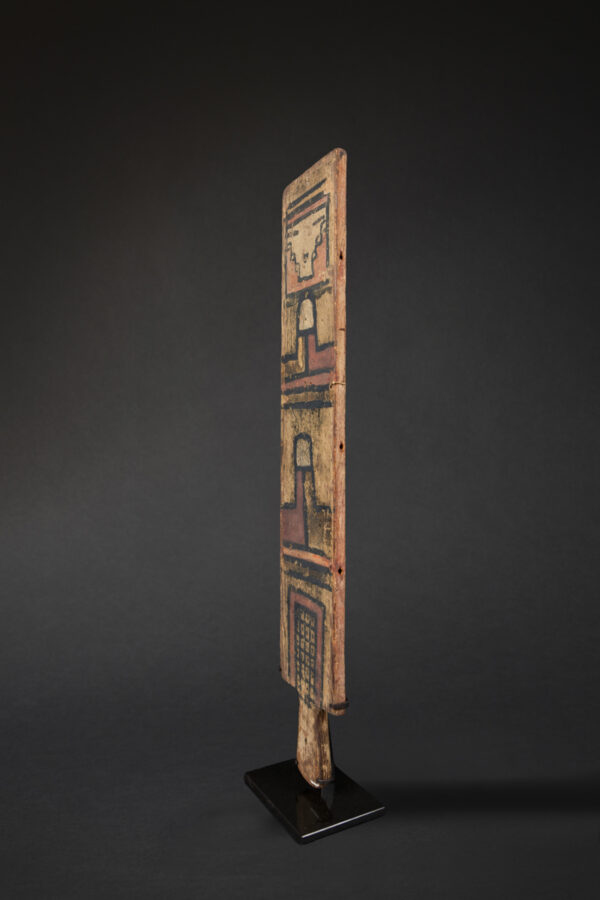
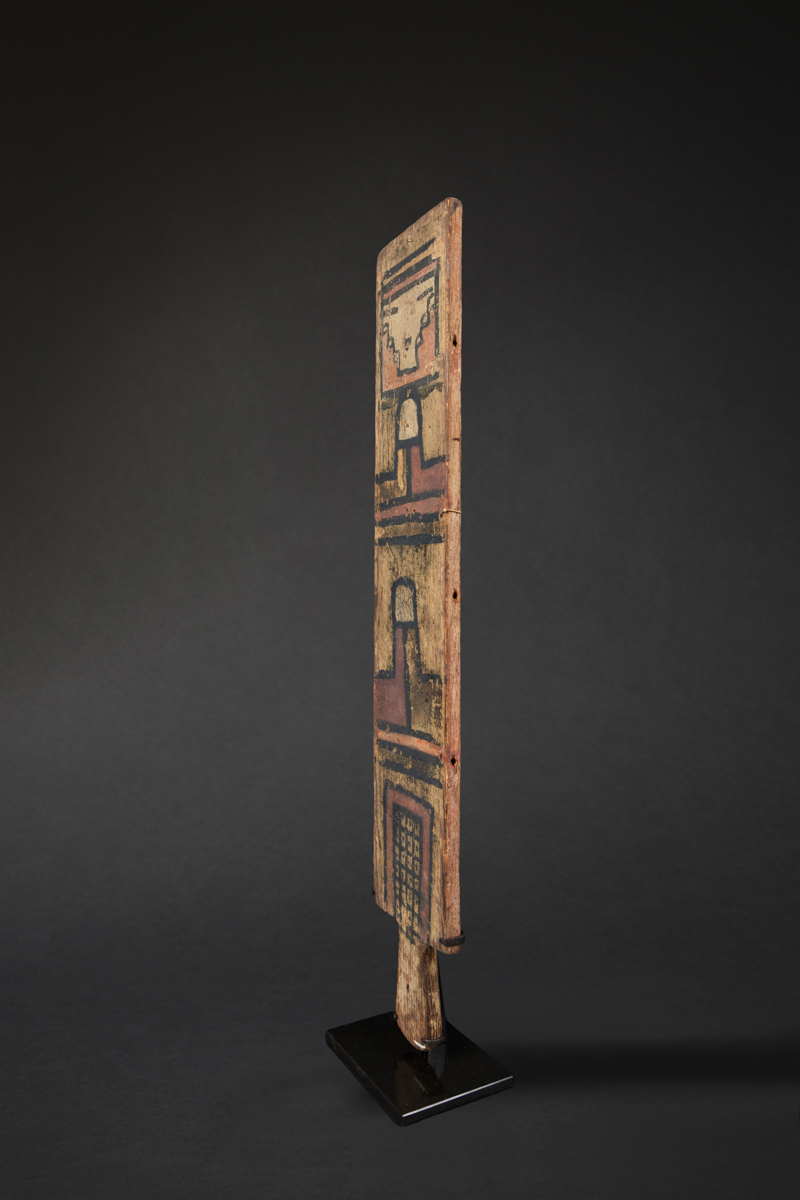
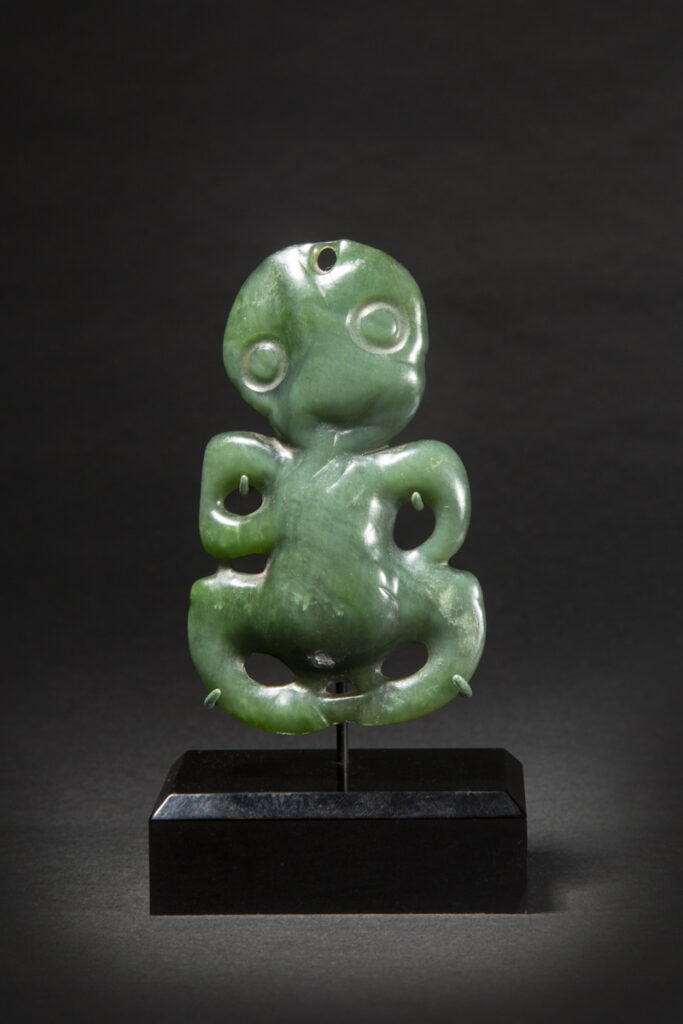
Dance Wand for a Katsina Ceremony
Poos’hum Katsina Paho
Hopi
Arizona, USA

Circa 1900
Carved wood and pigments
Height: 53.5 cm – 21 in.

Provenance
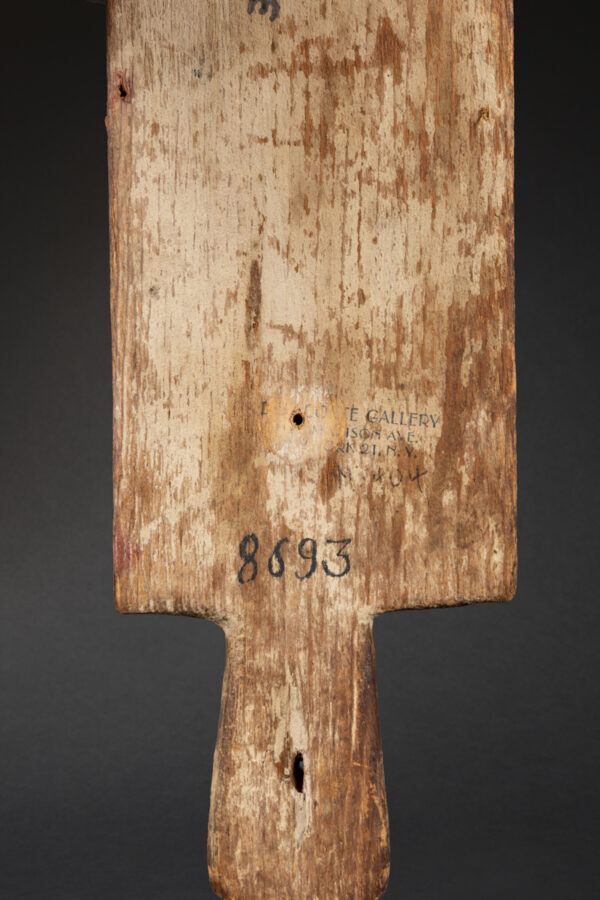
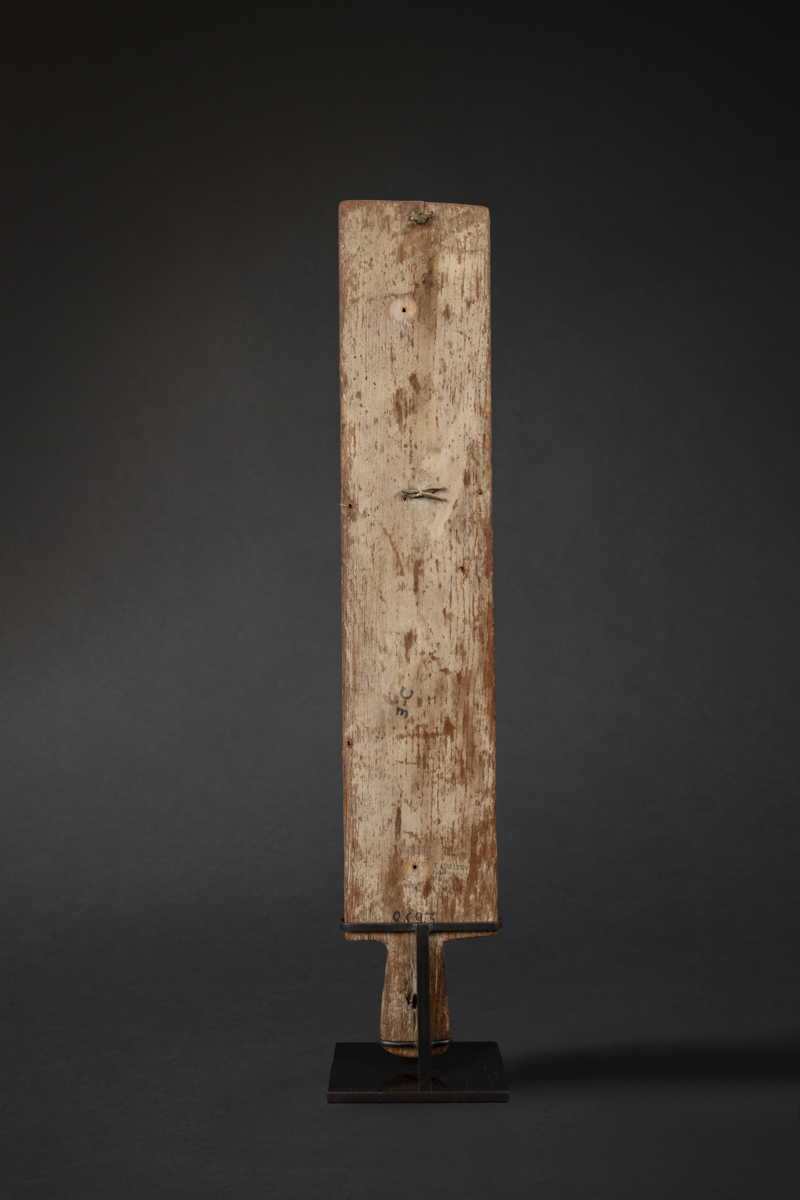
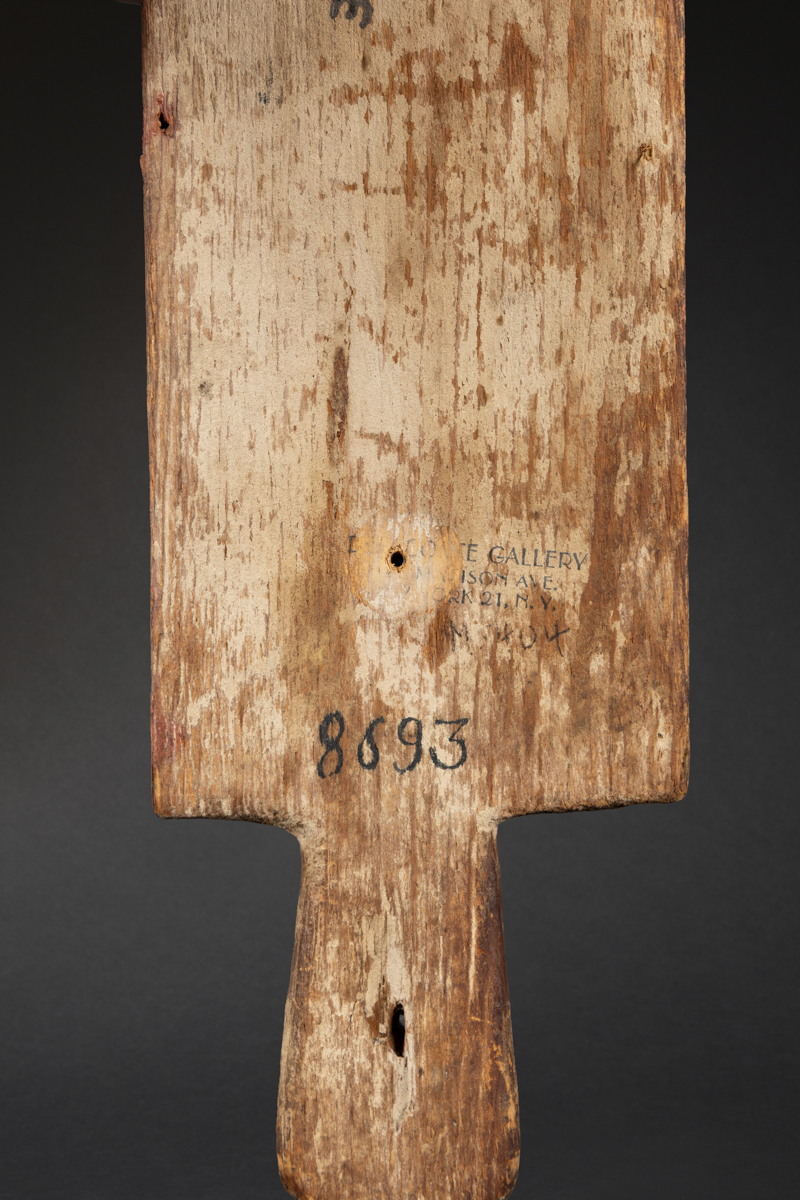
Inventory numbers: 8693, M(-)404 & 3-C
Delacorte Gallery, New York
Collection of the Surrealist artist Enrico Donati (1909–2008), New York
Sotheby’s, New York, “Important American Indian, African, Oceanic and Other Works of Art from the Studio of Enrico Donati”, 14 May 2010, lot 16
Collection Sheikh Saoud Al-Thani, Qatar

Hopi Dance Wand Donati / Galerie Flak Price: on request
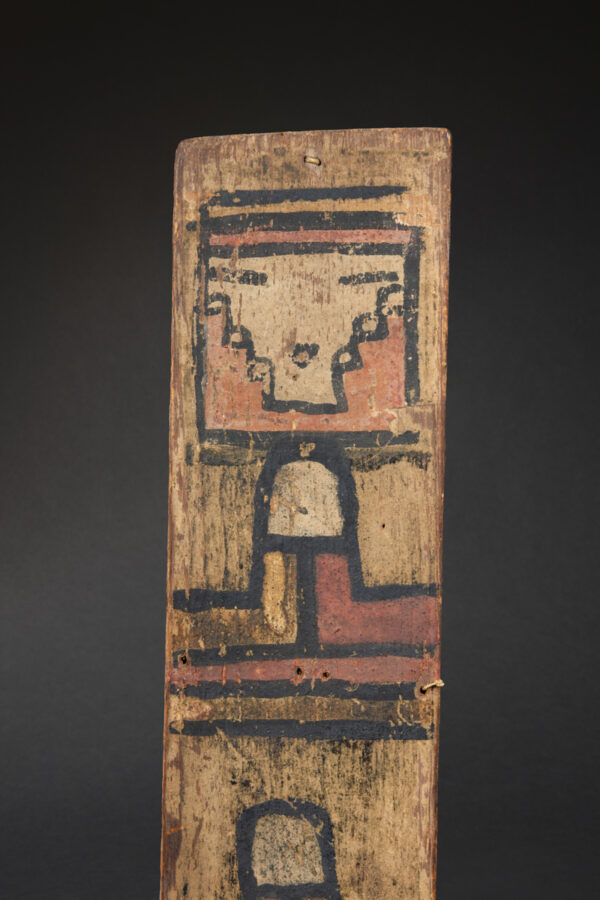
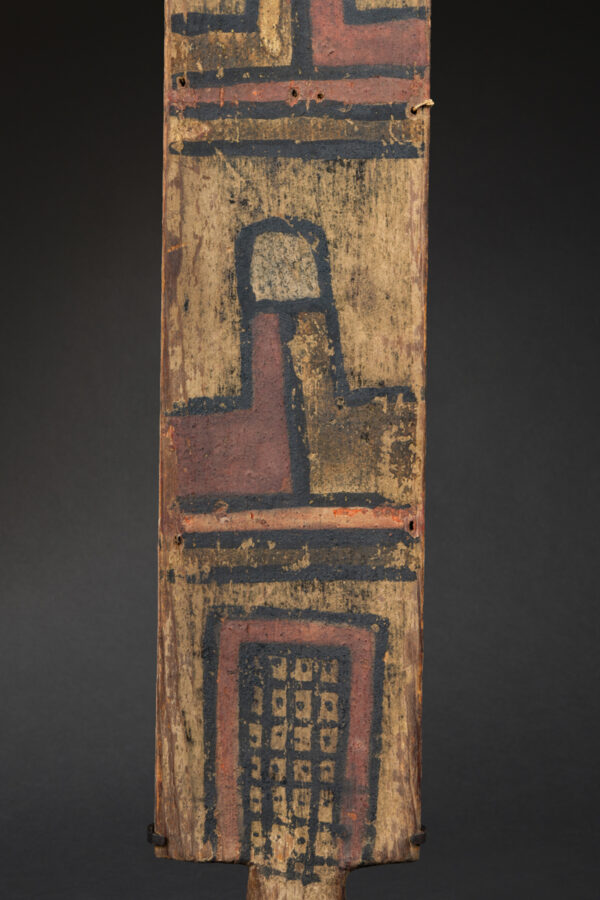
Rare and early Hopi ceremonial dance wand, featuring notably the mask of Pooshum (Seed) Katsina Spirit, associated with germination, and, on the lower part, motifs linked to maize. Beautiful mineral pigments, naturally oxidized over time.

This sculpture comes from the collection of the artist Enrico Donati (1909–2008), a prominent figure of the Surrealist movement. Initially trained in sociology and music, Donati later turned to painting. Of Italian origin, he lived in Paris and later in New York, joining the close circle of André Breton and other leading Surrealists, and brought new vitality to the movement through works imbued with mystery and organic forms.

In the 1930s, Donati developed a genuine passion for Native American art. Fascinated by ritual objects and the magical dimension of Indigenous creations, he visited Indian reservations in the American Southwest and northern Canada, spending several months among the Apache, Hopi, Zuni, and Inuit. During these stays, Donati exchanged European objects for Katsina figures, baskets, and masks, building a rich collection that left a lasting mark on his imagination.
This immersion did not lead Donati to a formal imitation of Native aesthetics, but rather to an embrace of a “primal” and magical spirit. Through matter and texture, he sought to reveal what lies beyond the visible. For him, Native American art acted as a catalyst of mysterious forces—an approach he strove to transpose into his own Surrealist works, where myths, enigmas, and symbols are in constant dialogue with the unknown.
For further insight into the importance of Native American art for Enrico Donati, see Marie Mauzé’s chapter “Surrealism and Hopimania” in "L’Appel des Kachinas – Katsina Calling" (Éditions l’Enfance de l’Art, 2024).

Video

Explore the entire collection
Kachina Collection
North America | Arizona
Kachina Collection | Arizona
North America | Arizona
Kachina Archives | Arizona
Discover our collections
CoLLECTIoNS

Katsina Doll

Uncategorized | Arizona

Katsina Doll

Arizona

Qöqöle Katsina
Hopi

Circa 1900 or earlier
Carved wood (cottonwood root) and pigments
Height: 14 cm – 5 ½ in.

Provenance
Collection John Molloy, Santa Fe
Private collection, New York

Published:
L’appel des Kachinas – Katsina Calling, Danielle Moretti-Langholz, Julien Flak, 2024, page 122

Exhibited and Published:
Les habités, l’art premier et l’art brut en dialogue, Daniel Klein & Antoine Frérot, Christian Berst art brut, Paris, 2025, page 106

Published: Katsina Calling, 2024
Qöqöle Katsina doll 14 cm / Galerie Flak Price on request
Katsina dolls (or Katsinam) represent spirits or gods from the pantheon of the Pueblo peoples in the American Southwest. Given to children, Katsina dolls constituted a pedagogical tool allowing them to familiarize themselves with the spiritual world and perpetuating knowledge of the founding myths on which their society was based.

Qöqöle Katsina belongs to both the Clown and Chief Katsina (Mong) categories. On the Third Mesa, Qöqöle appears during the Soyal ceremony and participates in the ritual by giving offerings of sacred cornmeal at the entrance of the kiva. On the other two mesas, Qöqöle makes an appearance four nights before the Powamu Dance. During the preliminaries of the ceremony, he promises good harvests and offers gifts to children. This has led non-Hopis to give Qöqöle the nickname of Santa Claus Katsina!

True to his clown nature, Qöqöle is known for all kinds of pranks, such as imitating women's dances or squatting on the floor and pretending to play marbles in the middle of the ceremony.
The color of Qöqöle's mask varies depending on the mesa and ceremony: it is white on the First Mesa, yellow (as is the case here) on the Second, and black on the Third.

Video

Explore the entire collection
Uncategorized
Uncategorized | Pierre-Gabriel Allaire
Uncategorized | Two in one Body
Uncategorized | Pierre-Pierre Le Moyne d'Iberville
Uncategorized | Les copains d'à Babord
Uncategorized | Chinese Party, May 11th, 1903
Uncategorized | Pierre's idolaters Society 1/89
Uncategorized | Pierre Loti, first Lieutenant in Mesopotamia
Uncategorized | Garance Rochechouart de la Tavannes and le Marquis Turpin de Crissé at the wedding of Odette and Georges Martin
Uncategorized | Osamu Akasegawa and Marie-Adélaïde Bassompierre de Côme at the wedding of Odette and Georges Martin
Uncategorized | Le Duc Maximilien-Théodore de Bavière and Hélèné-Cléménce de Fronça at the wedding of Odette and Georges Martin
Uncategorized | Le Comte Robert de Montbray and his wife at the wedding of Odette and Georges Martin
Uncategorized | Armance Vicomtesse de Hardi and Walter Van der Slikke at the wedding of Odette and Georges Martin
Uncategorized | Arizona
Uncategorized | Madam and Mister 112
Uncategorized | A studious student
Uncategorized | Arizona
Uncategorized | I put my white socks on
Uncategorized | The Three Sisters
Uncategorized | Blue beads Skull
Uncategorized | Pierre Loti, Family portrait
Uncategorized | Discs
Uncategorized | Rust
Uncategorized | Twist
Uncategorized | Natural
Uncategorized | Ambrotype
Uncategorized | Picasso with the gun and hat offered by Gary Cooper Cannes, 1958
Uncategorized | Creation of the fresco "La Guerre et la Paix" Chapel of Vallauris Castle, 1953
Uncategorized | Picasso on the set of H.G. Clouzot's movie "Le mystère Picasso", Nice 1955
Uncategorized | "Picasso's Eyes" Cannes 1955
Solarization
Uncategorized | La Mère grand
Uncategorized | Golden cannetille
Uncategorized | Chinese Cord
Uncategorized | Red Skull
Uncategorized | Marawot Figure
Uncategorized | Le Grand Sayatäsha
Uncategorized | Les bottines à boutons
Uncategorized | Portrait with Yup'ik mask & kachina
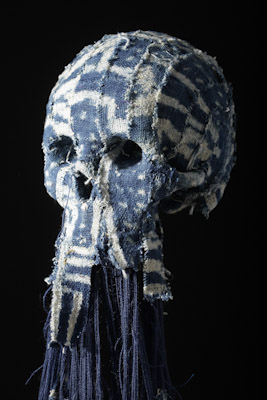
Uncategorized | Skull
Uncategorized | Colored Skull
Uncategorized | Skull - Blue Fabric
Uncategorized | The Kanak collector
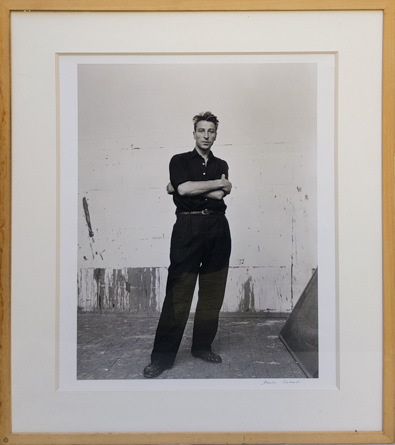
Uncategorized | Nicolas de Staël, 1954
Uncategorized | Console
Uncategorized | China
Uncategorized | Arizona
Uncategorized | New Mexico
Discover our collections
CoLLECTIoNS

Katsina doll

Uncategorized | Arizona

Katsina doll

Arizona

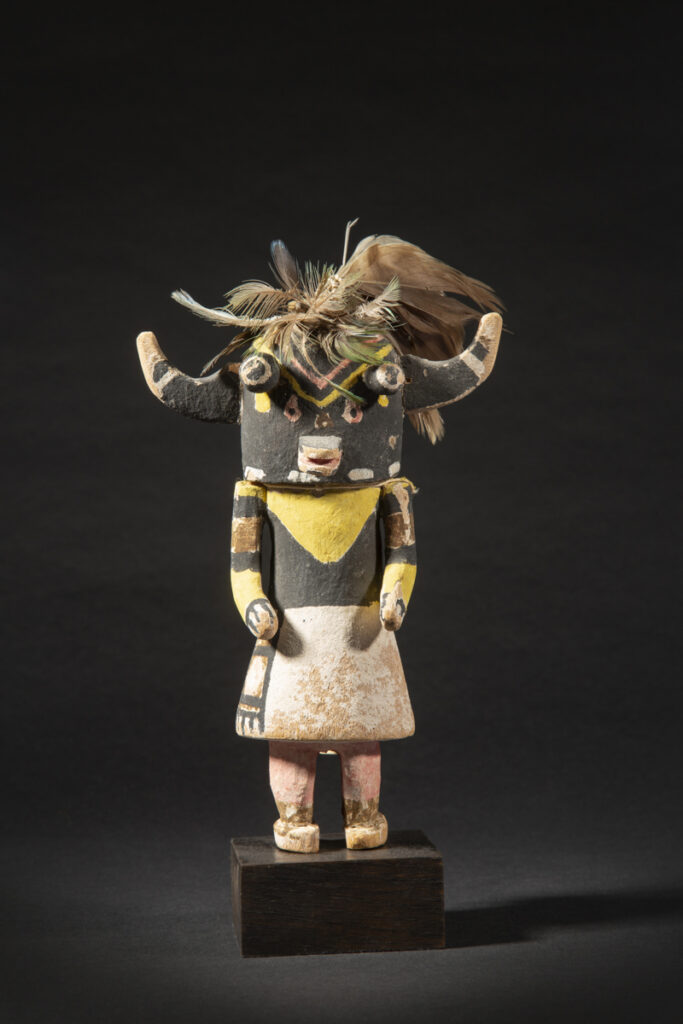
Chusona Katsina – Snake Priest figure
Hopi

Circa 1890-1900
Carved wood (cottonwood), leather and pigments
Height: 26.5 cm – 10 ½ in.

Provenance
Ex collection Alan Kessler, USA
Ex Sotheby’s New York, 4 Dec. 1997 lot 24
Ex collection Galerie Flak, Paris
Ex private collection, France

Publication
“Hopi Katsina, 1600 artists biographies”, Gregory Schaaf, 2008, page 23

Published: Katsina calling, 2024
Chusona Katsina 26 cm / Galerie Flak Price on request
Katsina dolls (or katsinam) represent spirits or gods from the pantheon of the Pueblo peoples in the American Southwest. Given to children, Katsina dolls constituted a teaching tool allowing them to familiarize themselves with the spiritual world and perpetuating knowledge of the founding myths on which their society was based.

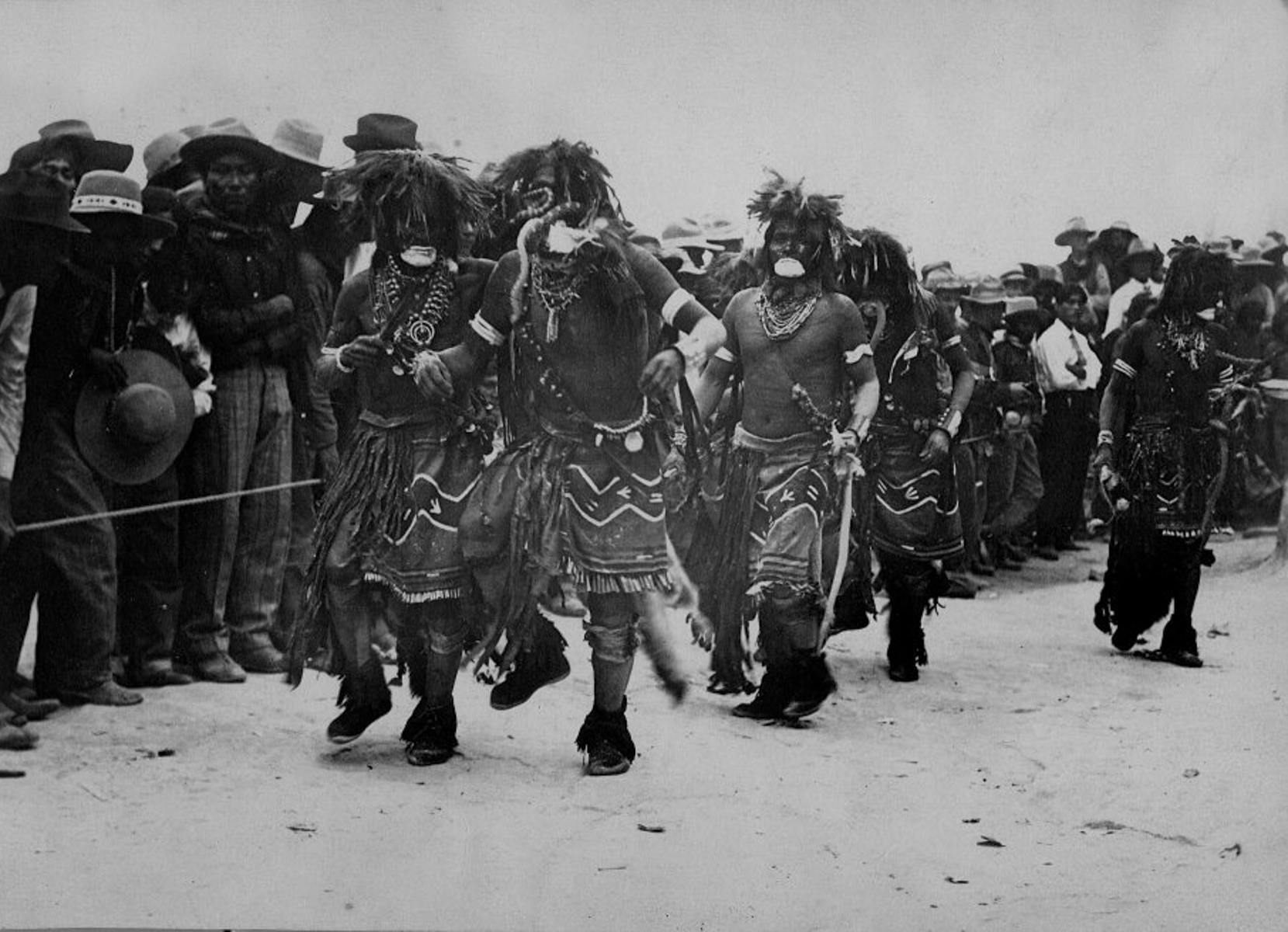
Pioneering ethnologist Abraham Moritz (Aby) Warburg (1866-1929) was the first to mention the Hopi Snake Dance ceremony. He traveled to the Pueblo region between 1895 and 1896 and stayed among the Hopi. Warburg observed that during the Snake Dance ceremonies, nature is symbolically provoked by a rattlesnake that ritual manipulations (including holding it in the mouth) transform into a catalyst for thunderstorms, bringing beneficial rain.
The Snake Dance takes place in the summer, after the end of the Kachina season, a time marked by thunderstorms and heavy showers. In August, Hopi hunters capture snakes (rattlesnakes and pit vipers) in the desert, which they confine for several days in ceremonial jars kept in the darkness of the kivas, the underground ceremonial chambers. Right before the ceremony begins, the snakes are subjected to smoke to make them drowsy or stunned.
According to Barton Wright, "like all major Hopi ceremonies, the Snake Dance is rich in concepts and symbols and serves several functions. It is primarily a prayer for rain and the cultivation of corn. The ceremony takes place at the end of the summer, when the corn needs rain the most to reach maturity and when the chances of rain are optimal. The warrior aspects are visible in the presence of symbols displayed by the dancers representing Pookanghooya, the Little War God, and traditionally worn by Hopi warriors in battle. Furthermore, the ceremony is related to ancestor worship, as the old members of the Snake Society are represented on the altar during this ceremony."
Dr. Edwin Wade (Museum of Northern Arizona, 1999) adds that the Snake Dance also incorporates elements of two migration stories related to the fraternal priesthoods of the Antelopes and Snakes. The Snake Dance itself occurs on the last day of a more elaborate ritual observance which originally spanned nine days. Preceding the dignified procession of Antelope priests into the dance plaza, the Snake Dancers arrive single file, animated by an aggressive, militant, demeanor. Immediately the Snakes break into units of three dancers, the Carrier, the Hugger, and the Gatherer.
The Carrier, depicted here, kneels before the ceremonial bower, and picks up a snake, which he holds between his lips as he rises and continues to dance. Huggers stand behind the Carrier and often have to "calm" the snake by fanning it with a feather wand. The Gatherer picks up the snake after the Carrier drops it, returning it to the ceremonial bower.

Video

The Snake dance
Hopi, Arizona
Anonymous
Circa 1912
Original silver print

Documentation

snakedance

The Dance of The Snakes - 1932

Explore the entire collection
Uncategorized
Uncategorized | Pierre-Gabriel Allaire
Uncategorized | Two in one Body
Uncategorized | Pierre-Pierre Le Moyne d'Iberville
Uncategorized | Les copains d'à Babord
Uncategorized | Chinese Party, May 11th, 1903
Uncategorized | Pierre's idolaters Society 1/89
Uncategorized | Pierre Loti, first Lieutenant in Mesopotamia
Uncategorized | Garance Rochechouart de la Tavannes and le Marquis Turpin de Crissé at the wedding of Odette and Georges Martin
Uncategorized | Osamu Akasegawa and Marie-Adélaïde Bassompierre de Côme at the wedding of Odette and Georges Martin
Uncategorized | Le Duc Maximilien-Théodore de Bavière and Hélèné-Cléménce de Fronça at the wedding of Odette and Georges Martin
Uncategorized | Le Comte Robert de Montbray and his wife at the wedding of Odette and Georges Martin
Uncategorized | Armance Vicomtesse de Hardi and Walter Van der Slikke at the wedding of Odette and Georges Martin
Uncategorized | Arizona
Uncategorized | Madam and Mister 112
Uncategorized | A studious student
Uncategorized | Arizona
Uncategorized | I put my white socks on
Uncategorized | The Three Sisters
Uncategorized | Blue beads Skull
Uncategorized | Pierre Loti, Family portrait
Uncategorized | Discs
Uncategorized | Rust
Uncategorized | Twist
Uncategorized | Natural
Uncategorized | Ambrotype
Uncategorized | Picasso with the gun and hat offered by Gary Cooper Cannes, 1958
Uncategorized | Creation of the fresco "La Guerre et la Paix" Chapel of Vallauris Castle, 1953
Uncategorized | Picasso on the set of H.G. Clouzot's movie "Le mystère Picasso", Nice 1955
Uncategorized | "Picasso's Eyes" Cannes 1955
Solarization
Uncategorized | La Mère grand
Uncategorized | Golden cannetille
Uncategorized | Chinese Cord
Uncategorized | Red Skull
Uncategorized | Marawot Figure
Uncategorized | Le Grand Sayatäsha
Uncategorized | Les bottines à boutons
Uncategorized | Portrait with Yup'ik mask & kachina
Uncategorized | Skull
Uncategorized | Colored Skull
Uncategorized | Skull - Blue Fabric
Uncategorized | The Kanak collector
Uncategorized | Nicolas de Staël, 1954
Uncategorized | Console
Uncategorized | China
Uncategorized | Arizona
Uncategorized | New Mexico
Discover our collections
CoLLECTIoNS

Hopi carved figure

Uncategorized | Arizona

Hopi carved figure

Arizona

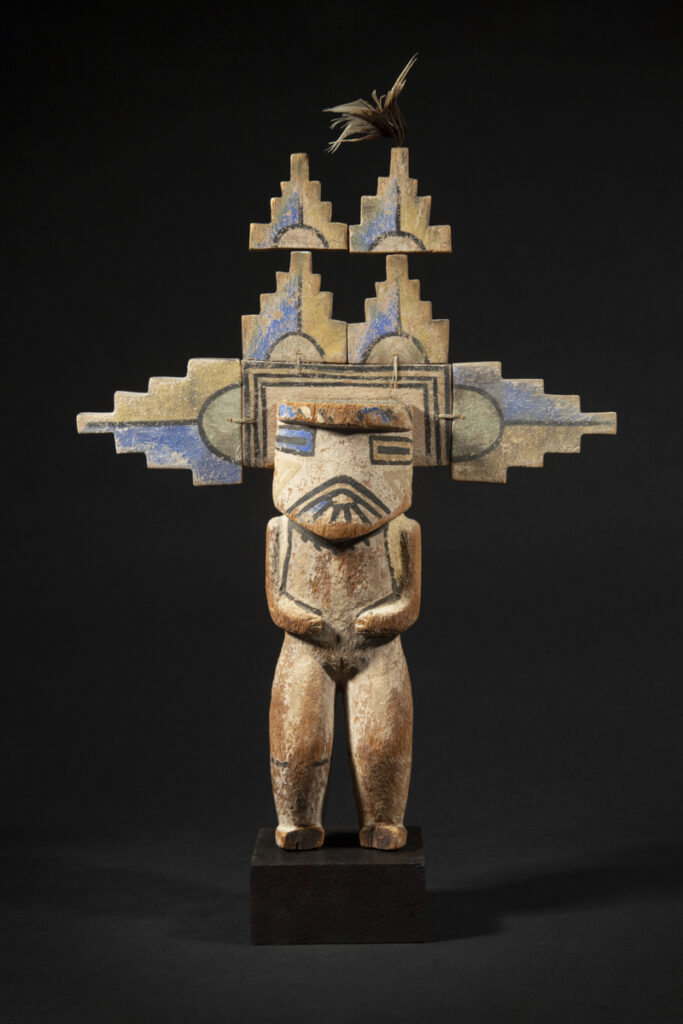
Social Dancer

Circa 1900s-1920s
Carved wood (cottonwood), pigments, corn fiber
Height: 21 cm – 8 ¼ in.

Social Dancer figure / Galerie Flak Price on request
Carved from cottonwood root, this Hopi figure represents a social dancer rather than a masked Katsina spirit, highlighting the artistry and diversity of Hopi Pueblo carving traditions. Unlike traditional Katsina dolls, social dancer figures frequently depict male or female participants from community ceremonies and do not wear masks—often showing individualized features, hairstyles, and dance attire. Such carvings commemorate non-Katsina performances integral to Hopi village life, reflecting both the ceremonial and social cycles observed in Arizona’s Hopi communities.

Vidéo

Explore the entire collection
Uncategorized
Uncategorized | Pierre-Gabriel Allaire
Uncategorized | Two in one Body
Uncategorized | Pierre-Pierre Le Moyne d'Iberville
Uncategorized | Les copains d'à Babord
Uncategorized | Chinese Party, May 11th, 1903
Uncategorized | Pierre's idolaters Society 1/89
Uncategorized | Pierre Loti, first Lieutenant in Mesopotamia
Uncategorized | Garance Rochechouart de la Tavannes and le Marquis Turpin de Crissé at the wedding of Odette and Georges Martin
Uncategorized | Osamu Akasegawa and Marie-Adélaïde Bassompierre de Côme at the wedding of Odette and Georges Martin
Uncategorized | Le Duc Maximilien-Théodore de Bavière and Hélèné-Cléménce de Fronça at the wedding of Odette and Georges Martin
Uncategorized | Le Comte Robert de Montbray and his wife at the wedding of Odette and Georges Martin
Uncategorized | Armance Vicomtesse de Hardi and Walter Van der Slikke at the wedding of Odette and Georges Martin
Uncategorized | Arizona
Uncategorized | Madam and Mister 112
Uncategorized | A studious student
Uncategorized | Arizona
Uncategorized | I put my white socks on
Uncategorized | The Three Sisters
Uncategorized | Blue beads Skull
Uncategorized | Pierre Loti, Family portrait
Uncategorized | Discs
Uncategorized | Rust
Uncategorized | Twist
Uncategorized | Natural
Uncategorized | Ambrotype
Uncategorized | Picasso with the gun and hat offered by Gary Cooper Cannes, 1958
Uncategorized | Creation of the fresco "La Guerre et la Paix" Chapel of Vallauris Castle, 1953
Uncategorized | Picasso on the set of H.G. Clouzot's movie "Le mystère Picasso", Nice 1955
Uncategorized | "Picasso's Eyes" Cannes 1955
Solarization
Uncategorized | La Mère grand
Uncategorized | Golden cannetille
Uncategorized | Chinese Cord
Uncategorized | Red Skull
Uncategorized | Marawot Figure
Uncategorized | Le Grand Sayatäsha
Uncategorized | Les bottines à boutons
Uncategorized | Portrait with Yup'ik mask & kachina
Uncategorized | Skull
Uncategorized | Colored Skull
Uncategorized | Skull - Blue Fabric
Uncategorized | The Kanak collector
Uncategorized | Nicolas de Staël, 1954
Uncategorized | Console
Uncategorized | China
Uncategorized | Arizona
Uncategorized | New Mexico
Discover our collections
CoLLECTIoNS

Katsina Doll

Uncategorized | Arizona

Katsina Doll

Arizona

Mother of Katsinam
Haha’i Wuhti Katsina Doll
Hopi, Arizona, USA

Circa 1920
Carved wood and pigments
Height: 21 cm – 8 ¼ in.

Provenance
Collection Steve Nelson, California

Haha’i Wuhti Katsina doll 21 cm / Galerie Flak Price: on request
Katsina dolls (or katsinam) represent spirits or gods from the pantheon of the Pueblo peoples in the American Southwest. Given to children, Katsina dolls constituted a teaching tool allowing them to familiarize themselves with the spiritual world and perpetuating knowledge of the founding myths on which their society was based.

The Katsina here is called Hahai-i Wuhti. She is said to be the Mother of the Katsinam. She is sometimes also referred to as "she who brings (or pours) water." During her appearances and dances, Hahai-i Wuhti constantly speaks to explain to the people how to behave and what they may have done wrong. She is also the Mother of Nataska (the Ogres) and the Mother of Dogs. Other Katsinam are also called mothers, as are all women of the same generation within a particular clan. Hahai-i Wuhti appears in various ceremonies, accompanying other Chief Katsinam. This includes the Shalako dance and the Water Serpent dance.

Video

Explore the entire collection
Uncategorized
Uncategorized | Pierre-Gabriel Allaire
Uncategorized | Two in one Body
Uncategorized | Pierre-Pierre Le Moyne d'Iberville
Uncategorized | Les copains d'à Babord
Uncategorized | Chinese Party, May 11th, 1903
Uncategorized | Pierre's idolaters Society 1/89
Uncategorized | Pierre Loti, first Lieutenant in Mesopotamia
Uncategorized | Garance Rochechouart de la Tavannes and le Marquis Turpin de Crissé at the wedding of Odette and Georges Martin
Uncategorized | Osamu Akasegawa and Marie-Adélaïde Bassompierre de Côme at the wedding of Odette and Georges Martin
Uncategorized | Le Duc Maximilien-Théodore de Bavière and Hélèné-Cléménce de Fronça at the wedding of Odette and Georges Martin
Uncategorized | Le Comte Robert de Montbray and his wife at the wedding of Odette and Georges Martin
Uncategorized | Armance Vicomtesse de Hardi and Walter Van der Slikke at the wedding of Odette and Georges Martin
Uncategorized | Arizona
Uncategorized | Madam and Mister 112
Uncategorized | A studious student
Uncategorized | Arizona
Uncategorized | I put my white socks on
Uncategorized | The Three Sisters
Uncategorized | Blue beads Skull
Uncategorized | Pierre Loti, Family portrait
Uncategorized | Discs
Uncategorized | Rust
Uncategorized | Twist
Uncategorized | Natural
Uncategorized | Ambrotype
Uncategorized | Picasso with the gun and hat offered by Gary Cooper Cannes, 1958
Uncategorized | Creation of the fresco "La Guerre et la Paix" Chapel of Vallauris Castle, 1953
Uncategorized | Picasso on the set of H.G. Clouzot's movie "Le mystère Picasso", Nice 1955
Uncategorized | "Picasso's Eyes" Cannes 1955
Solarization
Uncategorized | La Mère grand
Uncategorized | Golden cannetille
Uncategorized | Chinese Cord
Uncategorized | Red Skull
Uncategorized | Marawot Figure
Uncategorized | Le Grand Sayatäsha
Uncategorized | Les bottines à boutons
Uncategorized | Portrait with Yup'ik mask & kachina
Uncategorized | Skull
Uncategorized | Colored Skull
Uncategorized | Skull - Blue Fabric
Uncategorized | The Kanak collector
Uncategorized | Nicolas de Staël, 1954
Uncategorized | Console
Uncategorized | China
Uncategorized | Arizona
Uncategorized | New Mexico
Discover our collections
CoLLECTIoNS
Newsletter

Subscribe to our newsletter